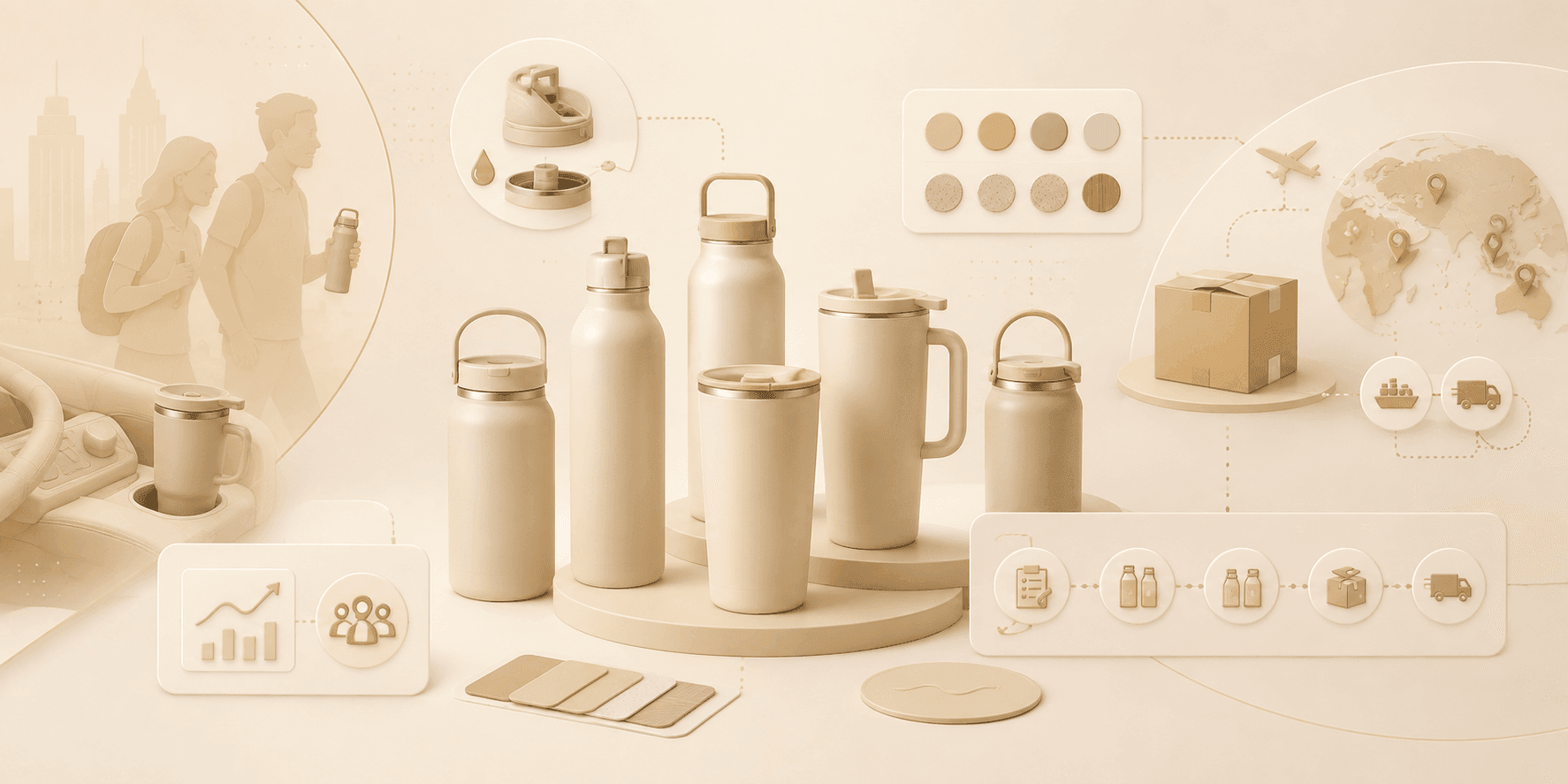


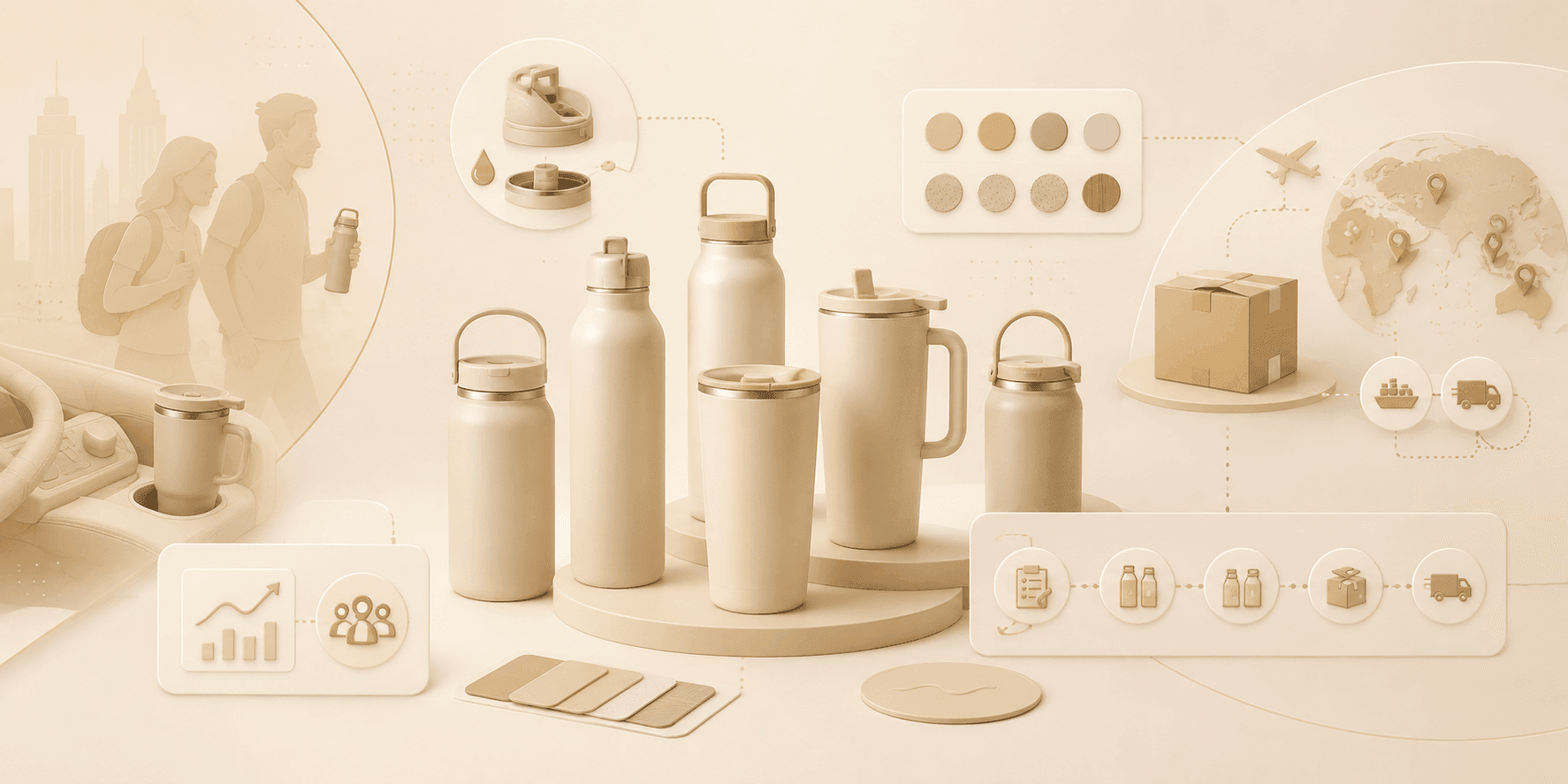
For distributors and branded merchandise suppliers, the important question is not simply which bottle brand is trending. Customer expectations are changing. Competition now extends beyond ounces and price into leak resistance, portability, modular accessories, brand colors, packaging, daily use cases, and the degree of customization a product can support.
As demand shifts toward higher-value semi-custom and fully custom programs, another challenge becomes more important: lead-time management. The biggest delays are not always in production or shipping. They often happen before the product leaves the factory, during color matching, sampling, revisions, and customer approval.
The Short Answer
The popularity of Owala, Stanley, and other large-format drinkware brands points to several broader market changes:
- Drinkware is already a mature, high-demand branded merchandise category. It represents a meaningful share of U.S. promotional product sales and ranks among the categories recipients most want to receive.
- Competition is moving beyond capacity. Leak resistance, cup-holder fit, cleaning, one-handed use, modular accessories, brand colors, and packaging increasingly shape product value.
- Different markets need different product strategies. Large-capacity drinkware fits North American driving, outdoor, and all-day hydration habits, while many Asian markets continue to favor lighter, more portable formats.
- More customization means more front-end decisions. Semi-custom and fully custom programs add time before the product leaves the factory through color matching, samples, material decisions, packaging, and approvals.
- Fast orders depend on approval speed as much as factory speed. For ready-made products, even a short customer delay can erase much of the original lead-time advantage.
The opportunity in drinkware is therefore not just to identify the next popular brand. It is to build a better operating model across product trends, customization, and order confirmation.
Drinkware Demand Is Still Strong, But Competition Is No Longer Just About Size
Large-capacity bottles became popular in North America for more than one reason.
Leading brands combined product functionality with health awareness, outdoor culture, commuting habits, and social identity. Drinkware moved from a basic household item into a product that can communicate lifestyle and personal taste.
Within the branded merchandise market, the category is also well established.
According to the ASI 2026 Ad Impressions Study:
- drinkware represents about 10.4% of annual U.S. promotional product industry sales
- the category is worth approximately $2.8 billion
- 41% of recipients say drinkware is one of the promotional product categories they most want to receive, placing it in the Top 5
- 87% retain branded drinkware because it is useful
- more than 75% use it at least weekly
- one drinkware item can generate roughly 1,300 long-term brand impressions on average
PPAI's 2026 research points in a similar direction. Seventy-three percent of respondents use branded bottles or tumblers daily, and 70% say durable, well-designed drinkware improves how they feel about a brand.
That makes drinkware valuable beyond the moment it is handed out. Its strength comes from frequent use and long retention, giving brands a recurring place in everyday life.
What Owala Represents: The Market Is Moving From “Bigger” to “Better to Use”
Stanley helped normalize large-capacity drinkware, but the market is moving into another stage.
Insights from ASI Show Chicago 2026 show suppliers differentiating through areas such as:
- sustainable design
- modular lids
- NFC-enabled interaction
- stronger retail-brand aesthetics
- positioning around everyday routines
In other words, drinkware competition is shifting from “how many ounces?” toward three broader dimensions.
1. Functionality
Consumers increasingly care about:
- leak resistance
- cup-holder compatibility
- ease of cleaning
- one-handed use
- straw, sip, or multi-mode lids
- replaceable or modular accessories
Capacity still matters, but capacity alone is no longer enough to stand out.
2. Customization Flexibility
For branded merchandise, the product's ability to become part of a brand experience matters just as much.
Customization can include:
- brand colors
- surface finishes
- logo and artwork placement
- individual names
- custom accessories
- gift boxes and packaging
- replaceable components
When enterprise customers want something that feels like “our product” rather than a standard item with a logo added, customization capability directly affects perceived value.
3. Fit With Everyday Use
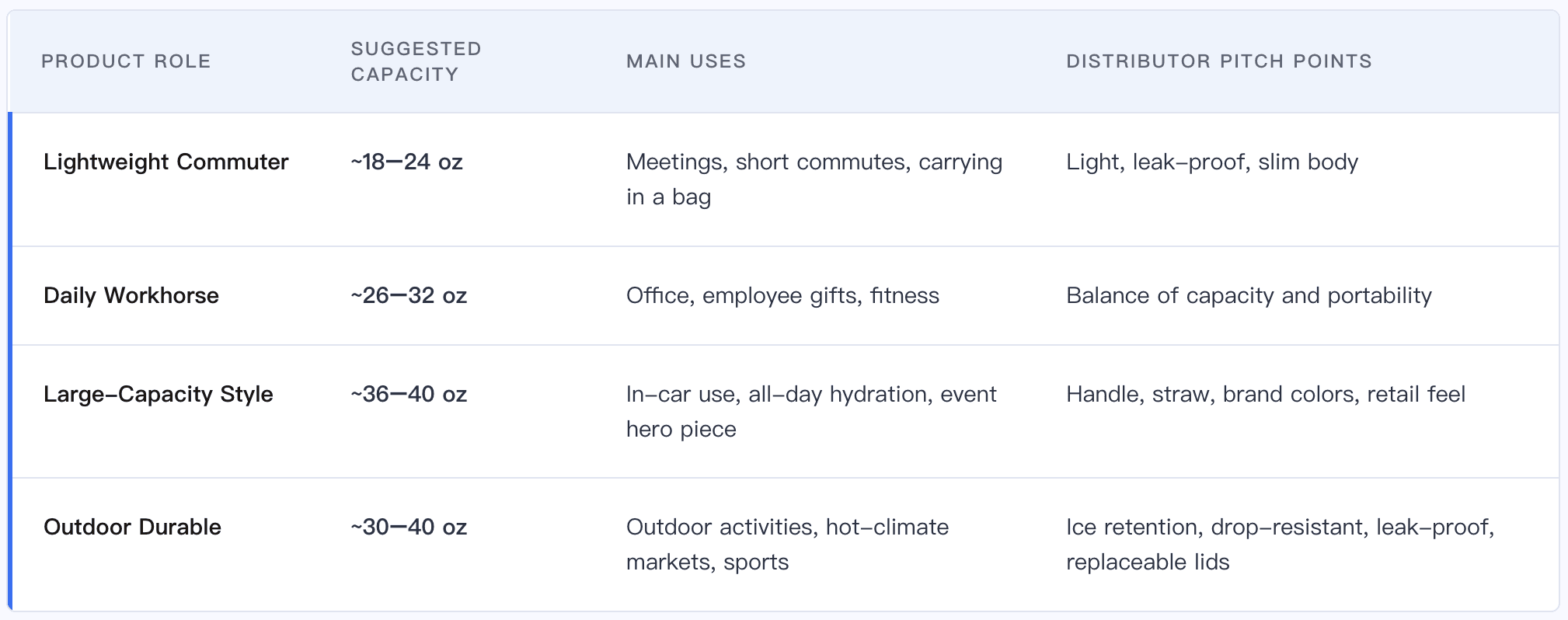
The same capacity can mean very different things in different markets.
In North America, driving habits, outdoor culture, and longer hydration windows make oversized drinkware easier to adopt. Consumers do not need to carry a 40-ounce bottle in a shoulder bag all day. It can sit in a car cup holder, on a desk, beside gym equipment, or at home.
Many Asian markets place more emphasis on:
- lighter weight
- bag-friendly form factors
- commuting convenience
- desktop use
- portability and compact design
That means product strategy should not simply copy the most popular North American format into every region. The usage context matters.
The Distributor Opportunity Is to Move From Ready-Made Products Into Higher-Value Customization
As drinkware becomes more lifestyle-oriented, enterprise customers are more likely to ask for brand colors, specialty coatings, custom packaging, different lids, or branded accessories.
That creates an opportunity for distributors to move beyond ready-made products into semi-custom and fully custom programs.
The three common supply models can be understood simply:
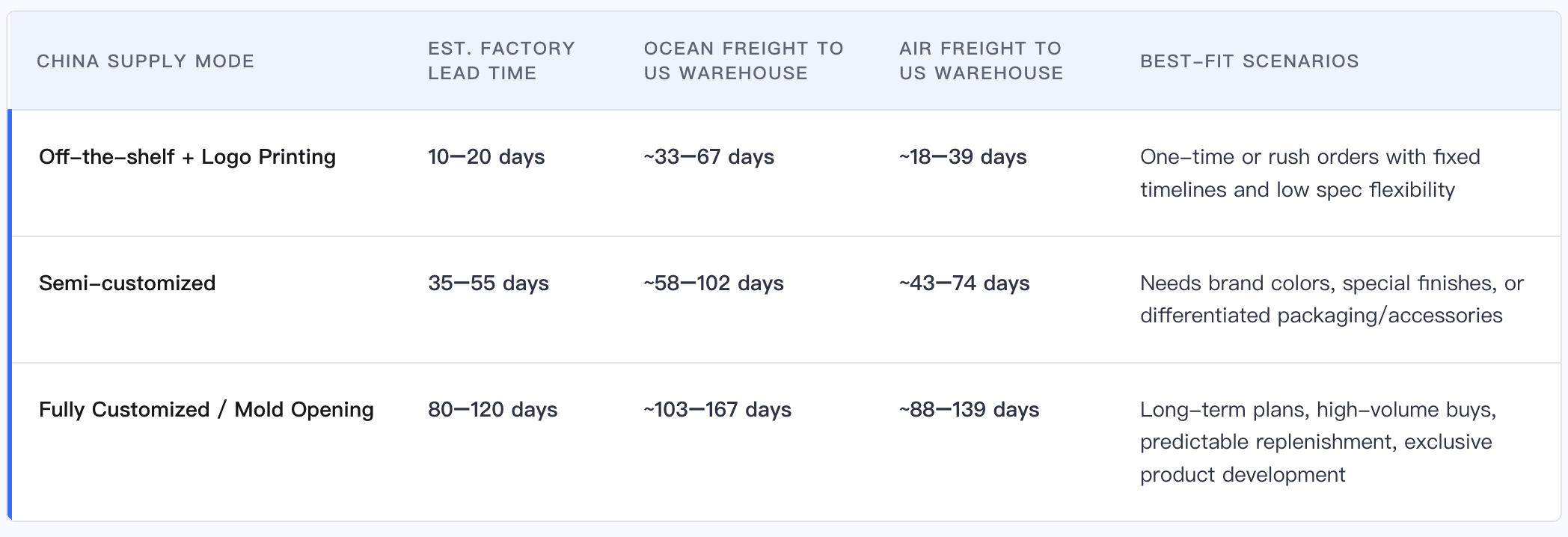
- Ready-made: use an existing product and color, then add a logo or basic decoration
- Semi-custom: keep the existing product architecture while adjusting brand color, finish, accessories, or packaging
- Fully custom: develop the structure, dimensions, materials, accessories, and packaging more extensively
As customization increases, brand differentiation and project value can increase as well.
But the workflow also becomes more complex.
The Extra Time in Semi-Custom Orders Happens Mostly Before the Product Leaves the Factory
A semi-custom program may appear to add only about a month compared with a ready-made order, but that additional time is not evenly distributed across shipping, customs, and delivery.
Most of the added work happens before or early in production, including:
- brand-color matching and approval
- surface finish or specialty coating tests
- custom sample production
- packaging, accessory, or material adjustments
- revised sampling
- additional quality and specification confirmation
By comparison, international freight, customs clearance, and domestic U.S. delivery usually do not increase dramatically just because the product moves from ready-made to semi-custom.
That means each supply model has a different management priority.
Ready-Made Orders Mainly Require
- inventory control
- decoration scheduling
- vessel or shipping schedules
- logo and placement approval
Semi-Custom Orders Mainly Require
- final design approval
- confirmed brand color
- clear sample standards
- a defined final approver
Fully Custom Orders Mainly Require
- structure and specifications
- material and functional testing
- multiple sampling rounds
- tooling and quality standards
- more detailed development milestones
Moving from ready-made to semi-custom is therefore not simply “adding more production days.” It introduces a separate pre-production workflow for color matching, sampling, testing, and approval.
Why Customer Approval Can Erase the Advantage of a Fast Supply Model
For urgent orders, one variable is easy to underestimate: customer confirmation time.
The same approval process may take 5 to 15 days, but its impact is very different depending on the supply model.
Using roughly 10 days of customer confirmation as an example:
- ready-made total lead time: about 50 days; confirmation represents 20%
- semi-custom total lead time: about 80 days; confirmation represents 12.5%
- fully custom total lead time: about 135 days; confirmation represents 7.4%
This means the fastest supply model is also the most sensitive to approval delays.
If a customer takes another week to confirm a logo, placement, or color, a large part of the time advantage of the ready-made option can disappear.
For ready-made products, the factory may need only a short decoration window, but late approval can still:
- miss the decoration schedule
- miss the planned vessel or shipping window
- compress quality-control time
- push back final delivery
For urgent programs, decision speed can matter more than factory speed.
What Fast Orders Should Manage First
When the timeline is tight, the first priority should be the approval workflow, not simply asking a factory to save another two or three production days.
More effective practices include:
- presenting a more complete product shortlist from the beginning
- using high-quality visual mockups
- confirming logo, placement, color, and packaging early
- clearly identifying which choices affect lead time
- assigning one final decision-maker on the customer side
- setting a specific approval deadline
- making it clear that each day of delayed approval usually shifts the delivery date as well
Visualization is particularly important.
When customers are making decisions from product names, specifications, and written descriptions alone, they are more likely to revise repeatedly. If they can see a near-final representation of the product, logo placement, color, and overall presentation from the start, confirmation can move much faster.
For fast-turn orders, locking the approval process early is often more effective than asking the factory to compress another two or three production days.
How Giftpack Helps
As drinkware becomes more design-led, customized, and experience-driven, distributors need to do more than find a product. They need to turn customer requirements into something that can be understood and approved quickly.
One goal of Giftpack's AI-powered proposal automation is to bring product selection, product information, customization direction, and visual presentation into a more efficient proposal workflow.
With clearer product recommendations and visual proposals, distributors can:
- organize different sizes, features, and styles faster
- compare ready-made, semi-custom, and fully custom options more clearly
- show brand colors, logos, packaging, and overall presentation earlier
- reduce repeated revisions
- shorten customer confirmation cycles
- lock in realistic lead times sooner
That makes proposal automation more than a design-efficiency tool. It can also become part of supply chain and lead-time management.
Final Takeaway
Owala's popularity is not simply the next brand taking a turn in the spotlight.
It reflects a broader stage in the drinkware market, where function, design, daily-use context, and brand experience increasingly determine product value. For distributors, the opportunity is not just to chase the next popular bottle, but to use stronger customization capabilities to turn drinkware into higher-value, retail-quality branded merchandise.
At the same time, more customization makes front-end confirmation more important.
From ready-made to semi-custom and fully custom programs, the right question is not only total lead time. It is which part of the workflow can still be improved. For urgent orders especially, reducing the time spent on product selection, visual review, and customer approval is often more effective than simply asking the factory to move faster.
Product trends create the opportunity. Confirmation efficiency determines whether that opportunity becomes an order.