


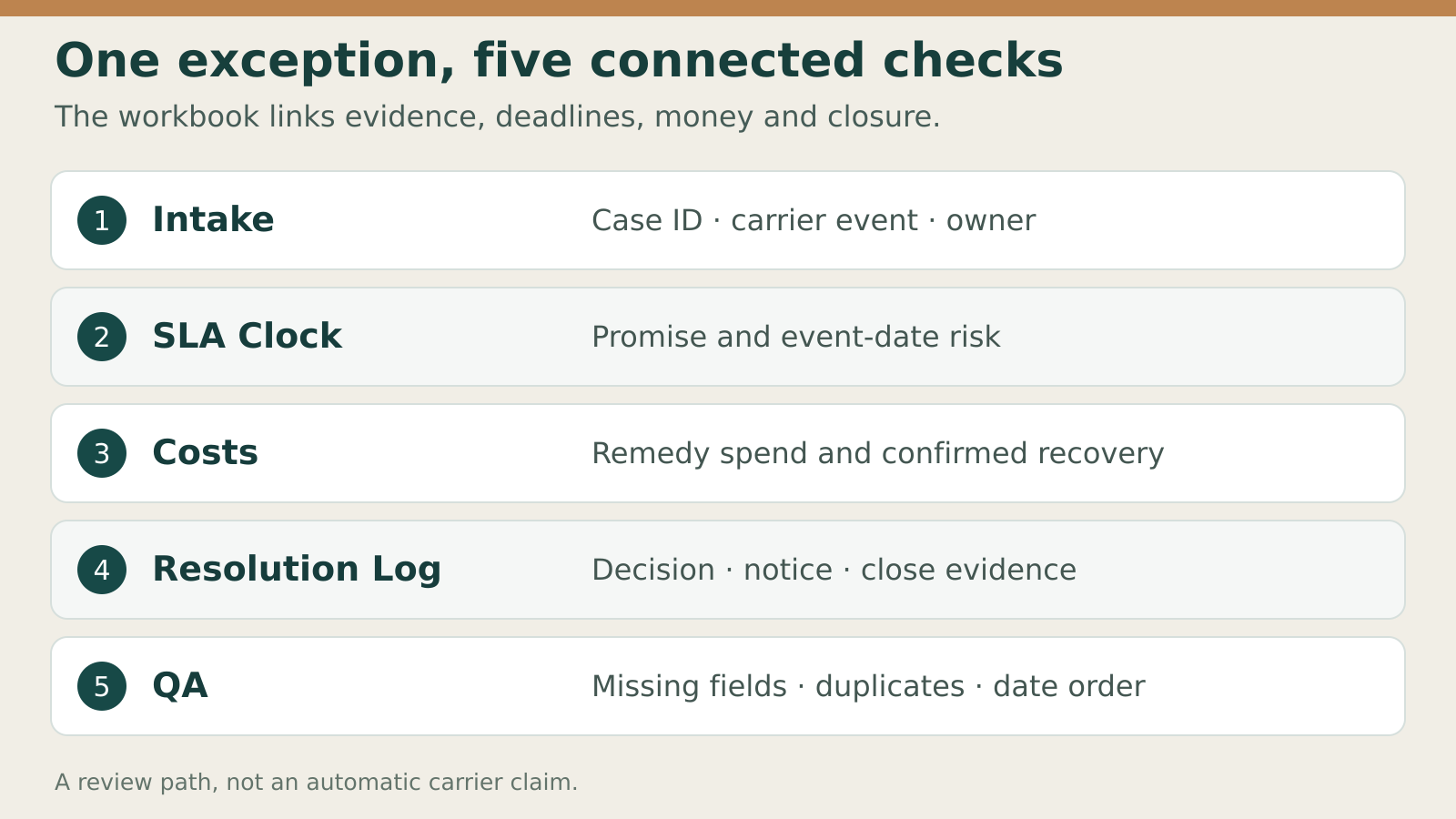
A shipping exception tracker should answer five questions in one view: what happened, who owns the next action, which recipient promise is at risk, what remedy was chosen, and what evidence proves the case is closed. The downloadable English workbook connects those questions across Intake, SLA Clock, Costs, Resolution Log, Dashboard, QA, and Read Me sheets. It is a carrier-neutral operating ledger, not a carrier claim form or a promise that every shipment can be intercepted.

What this tracker does—and what it deliberately does not
The workbook is for the moment after a delivery anomaly becomes a managed case. It records one case ID for each issue, a correlation ID for related contacts, an order and tracking reference, the exception type, dates, owner, status, last carrier event, and an evidence link. A separate clock shows age and whether the recorded recipient promise or event date has passed. The cost sheet totals replacement, reshipment, refund, and other expense, then subtracts carrier recovery. The resolution log requires a decision, an action owner, recipient notice, carrier evidence, and a close date before a closed case is treated as complete.
Those fields make a queue review possible without turning the spreadsheet into a second address book. Keep full home addresses, phone numbers, identity documents, and photographs in approved systems with appropriate access controls; put a minimum necessary reference in the ledger. The Universal Postal Union’s addressing resources are useful for thinking about destination-specific address elements, but the workbook is not an address validation service. Likewise, a tracking number is a reference to a carrier record, not proof that the recipient received a usable gift.
This article explains the ledger and its acceptance tests. For the earlier, broader decision of whether to intercept, reroute, replace, or refund, use the delivery-failure recovery guide. The tracker’s narrower job is to make those decisions observable, assignable, and reconcilable.
Download the current workbook and choose the right file
Download the seven-sheet English XLSX for live case management. If a support or fulfillment system needs only the intake columns, use the English intake CSV. That CSV is a header-only, UTF-8 template; it does not contain the formulas, dashboard, validation checks, or other sheets. Do not import it as if it were a completed exception record.
The XLSX begins with 100 blank intake rows. Before a team adopts it, choose one reporting currency and one case-ID rule, set the editable “As of” date on Dashboard, confirm who can edit each sheet, and decide where evidence files will live. Dates must be actual spreadsheet dates. Text that merely looks like a date may defeat age and date-order checks. The initial as-of value is 17 October 2026, the asset version date; update it for each operational review. A current date is not silently pulled from a user’s device.
The workbook is intentionally not connected to a carrier account or to Giftpack data. A team can use it with Giftpack-managed deliveries, a third-party fulfillment provider, or an internal mailroom. If the organization already has a trusted case-management system, use the same field definitions there and treat the spreadsheet as a review or migration aid. Do not run two ungoverned “sources of truth” for the same cases.
Define one case, one correlation key, and one owner
Start by choosing the unit of work. A case ID identifies one issue requiring a decision. A correlation ID connects multiple tickets, parcels, or messages that may describe the same shipment or recipient promise. An order ID identifies the commercial order; a tracking ID identifies a carrier consignment. These are not interchangeable. Two contacts about one delayed parcel may need separate service interactions but one coordinated remedy. Conversely, one bulk order can contain multiple parcels with different carriers and different exception states.
Give the case an owner who can move it, not merely a team name. The owner should know the next review time and the recipient promise. Capture the last carrier event with its timestamp and source, but do not overwrite an earlier event when the carrier changes a status. Preserve the original observation and link subsequent evidence. A status such as “delivered” can coexist with a recipient report of nonreceipt; the discrepancy is itself an exception to investigate.
The correlation check in SLA Clock flags repeated correlation IDs. It is a review prompt, not an automatic merge or deletion. Check whether two records share an actual shipment, whether two recipients are involved, and whether the original case has already triggered a replacement. False merges can hide a second lost parcel. False separation can produce duplicate reshipments. A supervisor should document the merge or split decision and preserve the original case identifiers.
When carrier data cannot be retrieved, mark that fact explicitly in the evidence reference and set a human next action. “No scan available” is different from “no scan occurred.” An internal operations owner can request a carrier trace, confirm warehouse tender, or contact the recipient through an approved channel. Close the evidence gap only with a verifiable result, not an assumed delivery state.
When the carrier record cannot be retrieved
Record the attempted lookup, its time and source, and the missing fact. Assign logistics to confirm warehouse tender or request a carrier trace; give support a time for the next recipient update. Keep the case open until an authorized owner records a verifiable result or an explicit decision about the unresolved gap.
Normalize exception types without flattening useful detail
Use a small common taxonomy to compare cases across providers, then retain the carrier’s exact event wording in the evidence record. A delayed scan, an address issue, a missed attempt, damage, apparent loss, return, and delivered-but-not-received report are distinct operational problems. “Exception” alone does not tell support what to say or finance what to reserve. Yet a taxonomy with a different code for every carrier message cannot be reviewed across a program.
| Common type | Minimum next check | Decision owner | Evidence to retain |
|---|---|---|---|
| Delay | Last verified movement and promised date | Logistics | Carrier event and revised plan |
| Address issue | Authenticated correction and action window | Support with logistics | Approved address version and carrier outcome |
| Damage | Safety, contents, packaging, and item availability | Claims owner | Permitted photos, claim reference, remedy |
| Apparent loss | Tender, scans, search and claim route | Logistics | Search or investigation result |
| Return | Return reason, inventory and recipient choice | Program owner | Return receipt and final disposition |
This is a triage table, not a universal list of carrier entitlements. For example, the USPS missing-mail page describes its own search process and information needs. It does not determine the rules for a private courier or another country’s postal operator. Store the service, origin, destination, account type, and applicable terms outside the simplified type field when those facts affect a claim. If the case involves customs, restricted goods, or sensitive personal information, route that decision to the competent specialist rather than letting the workbook infer a legal answer.
Read the clock as a promise-risk signal, not a carrier guarantee
The clock compares three dates: when the case opened, when the team promised an outcome, and when a gift matters to the recipient, such as an event. Dashboard’s editable as-of date drives the calculation. Age is the nonnegative difference between as-of and opening date. “Past promised date” appears only when the as-of date is later than the recorded promise and the case is not closed. Event risk is flagged when the as-of date has reached or passed the event date. The workbook does not know whether a carrier offers money-back service, whether a claim window is open, or whether an event can be rescheduled.
A case with no promised date needs a human decision; it should not be interpreted as safely on time. The date check flags a promise that predates the opened date. The required-field check flags missing order, carrier, tracking, exception type, or owner information. These flags help find an incomplete record; they are not an excuse to reject a recipient’s report because a carrier has not yet supplied a tracking ID. Log the exception and assign someone to obtain the missing identifier.
For daily reviews, sort first by safety or privacy exposure, then by event impact and remaining action window. Do not let the most visually prominent dashboard count decide priority alone. A single damaged high-value gift with a near-term executive presentation may need immediate containment while ten minor scan delays can wait for a scheduled carrier update. The global corporate gifting operations hub covers broader ownership and governance; this tracker supplies the case-level evidence that a program review needs.
If an event date has already passed, the operational question changes. An expedited reshipment may no longer protect the moment. The program owner may choose a recipient-approved alternative, a later delivery with an explanation, or cancellation. Record that choice and the communication date. Do not silently mark a late shipment “resolved” merely because it eventually moved.
Case one: a hypothetical conference gift delayed before the event
Consider a hypothetical conference program with 40 individually addressed gifts. One parcel shows no new carrier movement after tender. The recipient promise is 16 October, the conference is 17 October, and the team opens a case on 14 October. The tracker records a unique case ID, the order and tracking IDs, carrier, exception type “delay,” a logistics owner, the most recent scan reference, and an evidence link. The dashboard as-of date is 17 October. The promise is now past and the event date has arrived, so both signals should appear. These dates illustrate workbook behavior; they are not a claim about any actual shipment.
The owner first confirms whether the package was truly tendered. If not, the warehouse may still be able to hold or relabel it. If tender is evidenced, logistics asks the carrier for the available trace or service action. The program owner separately decides what recipient promise can still be honored. An expensive same-day replacement is not automatically preferable: stock may be limited, the recipient may leave the venue, and a second shipment may create a duplicate gift. A respectful notice and a confirmed post-event delivery may be a better fit. The alternative and the reason belong in Resolution Log.
Suppose the recipient approves a later delivery. Support records when the recipient was notified; logistics records the carrier trace; finance records any extra shipping cost and any later recovery; the program owner records the final decision and close date. The case is not complete simply because a parcel scan changed to “delivered.” Completion requires a documented remedy and the relevant evidence fields. If two attendees report the same tracking ID, investigate the data linkage rather than deleting one ticket.
Acceptance evidence for this hypothetical case is a dated carrier result, a recipient-facing decision, one accountable action owner, a reconciled cost line, and a complete closeout row. If the carrier search remains open, keep the case open with a next review date rather than backdating closure. A dashboard count should lead to a decision, not become the decision.
Case two: a hypothetical damaged gift with an apparent duplicate claim
In another hypothetical scenario, a recipient reports a crushed gift box and supplies permitted photographs. Support opens a damage case. A second message from an event coordinator arrives under a different ticket number but carries the same order and tracking reference. The Intake sheet retains both contact references in the approved support system while one case ID owns the remedy; the correlation ID prompts a duplicate review. The team must confirm the second message concerns the same parcel and recipient before merging. The workbook’s flag does not make that determination.
Claims staff preserve the package condition and check the relevant carrier’s evidence and timing rules. Product staff decide whether the contents are safe and suitable to resend. Finance estimates a replacement item, reshipment, refund, and other costs, then enters only confirmed carrier recovery in the recovery column. The net-cost formula is replacement plus reshipment plus refund plus other cost minus carrier recovery. A negative result is a QA prompt to inspect values and currency, not a profit claim. If a carrier credit is only requested, keep it out of confirmed recovery and annotate the claim state in the evidence system.
The choices are repair, replacement, alternative item, refund, or cancellation. If the product cannot be replaced before an event, offering the recipient a choice may protect the relationship better than dispatching an unsuitable substitute. A logistics owner can arrange the return while the program owner approves the remedy; neither should assume the other has notified the recipient. The resolution row captures the decision, action owner, recipient notice date, carrier evidence, any replacement tracking, and close date.
Acceptance evidence includes a safe disposition for the damaged item, a single authorized remedy, a recipient notice, a reconciled financial record, and an investigation result for the duplicate contact. If the carrier never provides the expected scan, preserve the gap and escalate through the actual service channel. Do not invent a claim number or assert eligibility from the workbook. If a privacy concern arises from the photographs or address, use the organization’s approved retention and access policy.
Reconcile costs without manufacturing a recovery
Exception cost is more than the price of a replacement gift. Reshipment, packaging, return handling, refunds, and manual effort can materially change the decision. The workbook’s Costs sheet records four cost inputs and a separate carrier-recovery field. All inputs should use one currency for a given workbook; otherwise a sum is mathematically valid but economically meaningless. If programs span currencies, convert through an approved finance process with a recorded rate and date, or keep separate ledgers. Do not let a spreadsheet silently choose an exchange rate.
Record spend when the organization is actually committed, according to the team’s finance policy. A proposed remedy can be noted in the case record without being booked as paid. Record a carrier recovery when confirmed, not when someone merely files a request. Net cost can help compare response models, but it does not substitute for customer impact, safety, contract duties, or the recipient’s choice. A refund and a replacement may both be appropriate in unusual cases, but a manager should confirm that the combination was intentional.
For trend review, group by exception type, carrier, service, destination, and root cause only when the underlying records are complete enough. A spike in “unknown” can indicate a data collection problem rather than a carrier performance change. The corporate gifting KPI guide explains broader measurement choices; here the important measure is whether each case’s actual remedy and cost can be reconciled to a source record. Keep any reported rate’s denominator, time period, and coverage explicit.
Make closure a test, not a status label
The Resolution Log is deliberately stricter than a simple “closed” dropdown. If Intake says a case is closed but the log lacks a decision, action owner, recipient notice, carrier evidence, or close date, the clock marks closure incomplete. That does not mean every carrier must admit fault. The evidence field can link to a documented investigation that found no carrier liability, a return receipt, or a verified “unavailable” outcome with an escalation decision. The point is to make the basis of closure inspectable.
Use a two-person review for material cases: the action owner confirms the operational result; a program or finance owner confirms the remedy and cost. For routine cases, a manager can review an exception sample and dashboard anomalies. Record who accepted the result and when in the approved system. Do not put the recipient’s full address or sensitive photographs in a shared workbook simply to make the row look complete.
A practical closeout checklist is:
-
Confirm the case and correlation IDs still map to the original order and tracking evidence.
-
Confirm the latest carrier state, including a known data gap, is dated and linked.
-
Confirm the recipient-facing decision and notification date.
-
Confirm whether a return, replacement, refund, or cancellation actually occurred.
-
Reconcile the cost and any confirmed recovery in one currency.
-
Verify the close date and handoff owner if follow-up continues outside this case.
If any item fails, reopen the case or move it to a clearly owned follow-up state. A closed status is an assertion; the evidence is what makes it auditable. The QA sheet contains boundary checks for promise dates, duplicate correlation and zero-cost math, plus live counts of missing fields and date-order defects. Its test cells are hypothetical. They do not certify that a particular carrier or organization will perform correctly.
Implement the workbook without creating a second source of truth
Pilot the tracker on a small set of historical, de-identified cases. Map each source field to Intake, document which team owns the value, and compare the workbook flags with the existing case record. Check one ordinary delay, one apparent duplicate, one missing tracking ID, one promise dated before opening, and one closed case with missing evidence. This is a verification exercise, not a fabricated performance claim. Decide whether the ledger will be the primary queue, a temporary migration tool, or a weekly control extract.
For active use, designate support as the first-contact owner, logistics as the carrier-evidence owner, the program owner as the recipient-promise decision maker, and finance as the cost reconciler. Your organization may combine roles, but the decisions must still be explicit. Define a review cadence keyed to actual carrier events and the event date. The sheet contains no automatic messages, claim submissions, carrier integrations, or legal determinations. A human must verify the current carrier rule and authorize any reroute, replacement, or claim.
Use the Intake CSV only for a controlled import. Its headers are localized and correspond to the 13 Intake columns; it is not a substitute for the seven-sheet workbook. Test imports in a staging copy, map date types, and check that leading zeros in order or tracking IDs remain text. Export a reconciliation count and sample rows before replacing a live queue. If a carrier event feed is later connected, keep the raw event ID and timestamp in the source system; update the ledger only through a documented mapping. This avoids turning a late duplicate event into a second case.
Refresh the template quarterly and whenever a material carrier-state, promise, or cost taxonomy changes. Version the file and retain the prior map. The current v1.0 fields reflect a carrier-neutral method verified on 17 October 2026, with official postal examples from the United States, Taiwan, Japan, and Korea. They do not establish a universal claim period or service guarantee. Local terms and contractual rights need their own current review.
Conclusion: close the promise, evidence, and money together
An effective shipping exception tracker is a decision instrument, not a prettier list of late parcels. It links one issue to a clear owner, an evidenced carrier state, the recipient’s actual deadline, a chosen remedy, and a financial result. The workbook makes missing fields, dates out of order, duplicate correlation IDs, promise risk, and incomplete closures visible; the team still has to interpret and act on them. Start with a controlled pilot, verify the formulas against real but de-identified records, and keep the carrier’s current rules beside the case—not embedded as universal spreadsheet logic.
Giftpack can be one execution layer for a corporate gifting program that coordinates gifts and fulfillment. Whether a shipment is managed there or elsewhere, use the same case IDs, ownership and closure evidence so a recipient promise does not disappear between systems. The workbook remains a neutral control artifact; Giftpack does not replace the carrier, the employer’s privacy decisions, or a claims specialist.