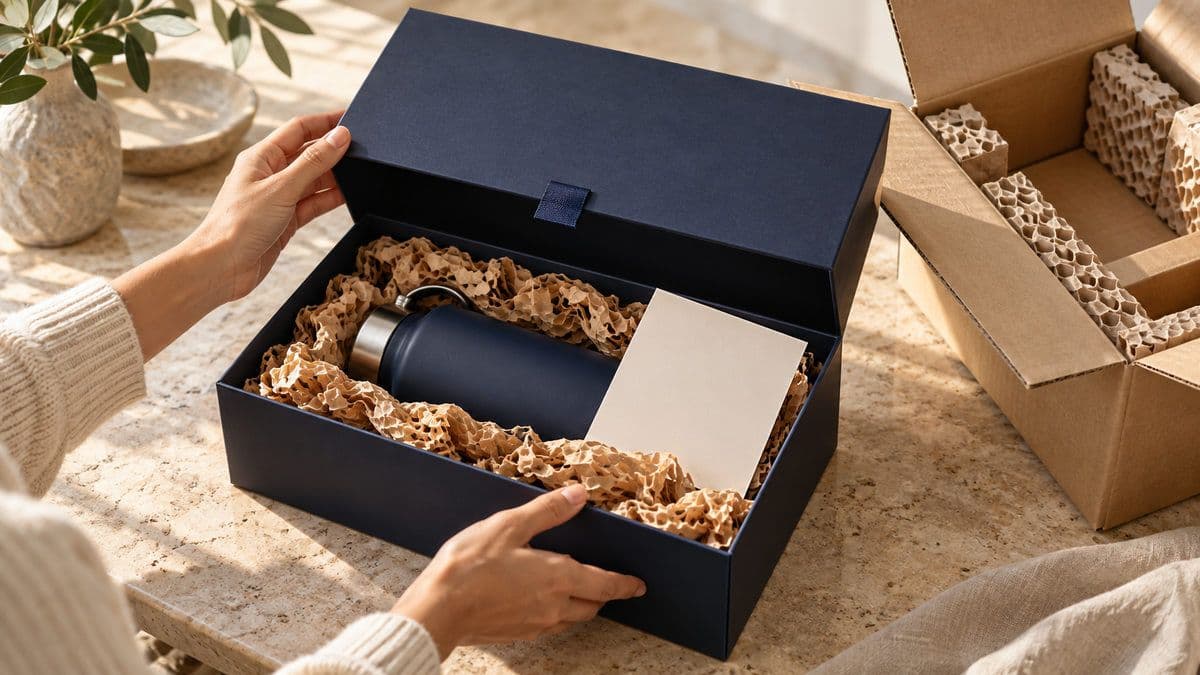

The unboxing experience begins before a recipient sees the gift. A crushed outer carton, a confusing address label, an insert in the wrong language, or a closure that is difficult to open can undo a carefully chosen item. A useful design process treats the parcel as a sequence of decisions: survive the route, let the recipient recognize and open it, explain the gift without demanding attention, make the item usable, and give each material an honest next life. This guide turns that sequence into a prototype and acceptance plan for brand, procurement, fulfillment, and recipient support teams. It uses official sources verified October 6, 2026, and two explicitly hypothetical cases; neither case is a Giftpack customer result.
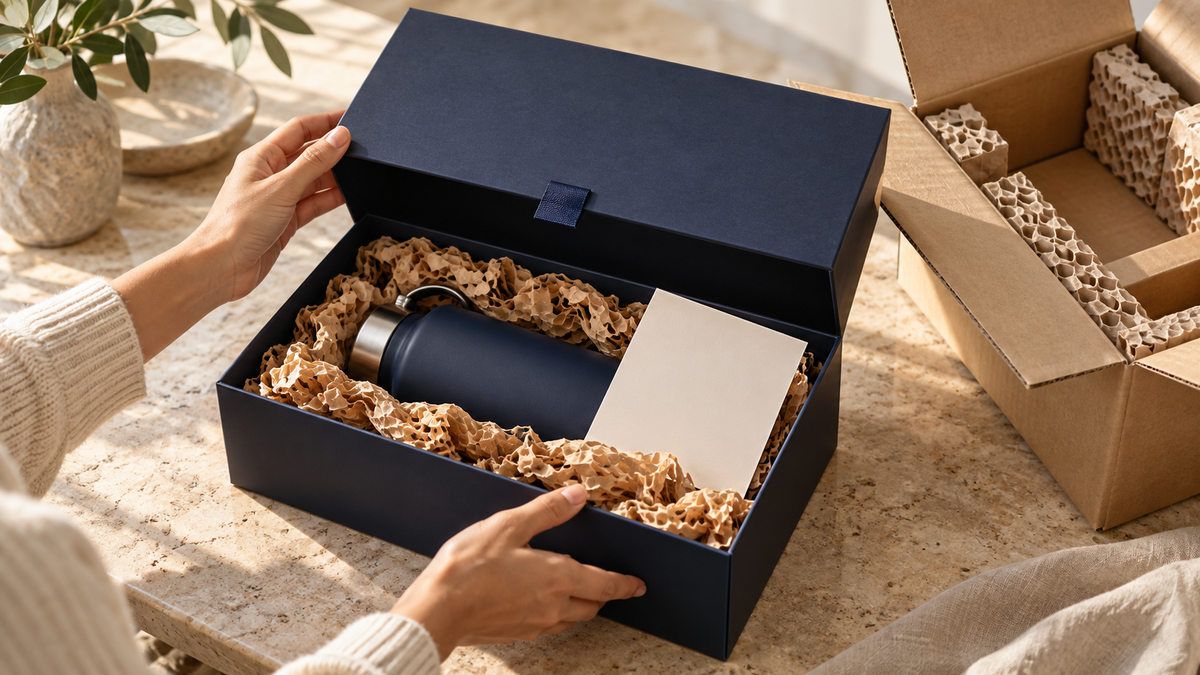
Figure 1. The recipient encounters the shipping protection, opening mechanism, message, product and leftover material as one connected experience.
Map the moment from doorstep to disposal
Begin with the actual route, not a mood board. A hand-delivered executive kit and an individually shipped employee kit face different handling, identification, privacy and waste conditions. Write the path as five moments: outer arrival, access to the package, first view of the contents, use of the gift, and storage, reuse or disposal. At each moment ask what the recipient must know or do. A beautiful inner box is not a success if the outer carton leaks a surprise, hides a required warning, or is impossible to remove without tearing the item inside.
The program owner should record the intended recipient, address collection method, delivery geography, item dimensions and weight, known fragile surfaces, any temperature or food constraints, and the permitted presentation budget. Procurement adds supplier lead times and minimum quantities. Brand defines one message hierarchy rather than several competing slogans. Fulfillment explains its carton sizes, assembly steps, available protective materials, carrier handoffs and return path. Recipient support identifies where to direct a damaged or inaccessible package. This short specification becomes the baseline against which both an attractive photograph and an ordinary assembled parcel are judged.
Use one observation sheet per opening. Time how long it takes a person to recognize the correct side, find the opening, remove the item, understand the card and dispose of the materials. Record any tool required, excess force, tiny print, loose filler, sharp edge, confusing seal or unexpected smell. These observations are design evidence, not a universal accessibility certification. Invite participants with different mobility and sensory needs, pay them for meaningful testing, and let them describe the experience in their own words. Do not infer that a package is accessible from one designer's demonstration.
Decide which facts belong on the outer parcel, the inner card, and the digital invitation. Shipping and safety information should be discoverable without ruining the occasion; instructions should not depend solely on a decorative card hidden under the item. A digital route may carry extended directions, but the physical package must still have enough information for a recipient who cannot or does not scan a code. Keep the layers coherent: if the insert promises a reusable vessel, the protected product and care information must match that promise.
For the broader operating model, use Giftpack's global corporate gifting operations hub. Prototype with plain materials, test the route, then invest in finishes.
Separate protection from presentation
Outer transit packaging and inner presentation packaging have different jobs. The shipper must hold the item through handling and protect it from predictable shocks, compression and weather exposure. The inner structure positions the item for a clear first view and a manageable removal. Sometimes one well-designed package can do both; sometimes a premium gift box still needs an outer carton. Make the boundary explicit so no one cuts protective material solely to improve a studio photograph.
The International Safe Transit Association describes procedures ranging from early design screening to simulations of distribution hazards. Its published procedures help teams choose an appropriate test for a product and shipment route. A casual office drop is useful as a quick prototype screen, but it is not an ISTA certification or proof that every carrier path will succeed. Specify the packed product, orientation, weight, route assumptions, selected procedure, laboratory or internal method, pass/fail condition and inspection record before claiming that a design passed. If the shipment changes, the evidence may need to change too.
Create at least two physical builds, not just rendered concepts. One can use a simpler corrugated structure with a shaped paper cradle; the other may use a rigid inner box and separate shipper. Compare material cost, assembly time, packed weight, parcel dimensions, damage, ease of opening and material sorting. The rigid box may be worth its cost for a hand-delivered occasion but create extra freight and disposal for a distributed program. Conversely, a light pack that looks efficient on a spreadsheet can fail if it allows a metal bottle to strike a fragile insert during transit.
Photograph a representative sample before sealing, after transit testing, and after opening. Do not quietly repair a dented corner for the acceptance photo. Record item movement, scuffing, leaks, crushed cushions and whether the message remained legible. If one prototype fails, identify whether the cause is an oversized cavity, inadequate restraint, the wrong outer grade, assembly variation or a carrier condition beyond the original assumptions. Revise only the affected layer and repeat the relevant test with the final packed mass.
The transit sample must be assembled by the intended production process. Show the actual label, sealing and pickup condition; a specially hand-built sample can hide inconsistent assembly.
Build an opening sequence people can use
Opening resistance is a product decision. A pull tab can make access clear, but only if the recipient can see it, grasp it and pull it without unreasonable force. Magnetic closures can look elegant, but they may add weight or make the correct opening less obvious. Ribbon and nested trays can offer a reveal while also creating multiple small tasks for someone with limited dexterity. Prototype the closure alongside the actual item, protection and printed materials. Test it after transit, when corners and tabs may have shifted.
Avoid treating digital accessibility guidance as a physical-packaging certificate. The W3C Web Accessibility Initiative describes perceivable and operable principles for web content; these are relevant to a digital invitation or online care instructions. For the box itself, define practical physical observations: can a recipient identify the opening without relying only on color, hold the parcel steady, remove the item without a sharp tool, and read or obtain the essential message in an appropriate format? W3C does not certify the force required to open a carton. Real user testing and product-specific assessment are still needed.
Offer a help route and accessible instructions to everyone. Product and compliance owners must review scented or food items and local labeling. A recipient should not have to disclose a disability to find an opening instruction, and must be able to decline the gift.
The insert should answer three questions in a sensible order: why this was sent, what the recipient can do next, and where to get help. Write a short human message before adding a product claim or QR code. Print size and contrast should work in the actual light and material, not only in a digital proof. Check that a scan destination is HTTPS, current, mobile usable and presented with a readable fallback URL or support route. If the physical card goes through international assembly, proof the correct language and recipient segment at the point of packing.
Acceptance testing is a small observed task, not a survey asking whether a mockup looks premium. Give participants a packed parcel without coaching. Observe first action, time, errors and whether they find the care and support information. Ask what felt uncertain and what they would keep. Revise the closure or hierarchy if several people stop at the same point, even if the brand team prefers the original reveal. A simpler sequence can feel more respectful than a dramatic series of seals.
Use a decision table for the material tradeoffs
The following is a reusable design worksheet, version October 6, 2026. Add an owner, tested sample identifier, local-market requirement, result and unresolved issue to each row. The entries are decision prompts, not performance guarantees. Keep the same criteria when comparing supplier proposals, so a low unit quote does not omit assembly, damage or disposal costs.
| Decision | Useful default question | Evidence before approval | Common failure and response |
|---|---|---|---|
| Outer carton | Will the packed item survive the actual route and still be easy to carry? | Packed dimensions, route assumption, representative transit test and inspection photos | Damage or excess space: change fit/protection and retest |
| Inner support | Can the item be found and removed without loose filler or a sharp tool? | Assembly sample, recipient opening observation and post-shipment item check | Item shifts or sticks: revise cradle and opening clearance |
| Closure | Is the opening visible and usable across realistic hand strength and lighting? | Observed tasks with diverse participants and a transit-aged sample | Hidden tab or excessive force: simplify and retest |
| Insert | Are purpose, next step, care and help clear in the right language? | Printed proof, translation review, segment-to-version assembly check | Wrong or unreadable card: quarantine batch and replace |
| Environmental statement | Which exact component, market and end-of-life route does the claim cover? | Material specification, substantiation and qualified market wording | Unsupported broad claim: remove or narrow before print |
| Experience result | What happened after delivery rather than only after dispatch? | Damage, opening, help, returns and disposal feedback with denominators | High complaints: isolate segment and repair the affected layer |
The table is also a handoff contract. Brand owns the message and printed proof; procurement owns supplier specifications and commercial assumptions; fulfillment owns packed configuration and inspection; legal or compliance reviews claims that require it; recipient support owns a usable response when the experience fails. Nobody should close a row with “looks good” when the required evidence is a shipment or an observed opening. A row with no evidence remains pending, even if the prototype photograph is attractive.
For substitutions, record a dated sample and reassess changed rows. Paper stock can alter contrast and claims; cushioning changes size; closures change opening force. Retest the affected configuration.
Make environmental statements specific and supportable
“Sustainable packaging” is too broad to describe a single nice-looking box. The U.S. Federal Trade Commission's Green Guides summary explains why environmental marketing claims need substantiation and why recyclability statements may require qualification where collection is not widely available. This is U.S. guidance, not a blanket approval for every country in a global program. Local market teams should review applicable law and actual collection routes before print. Do not assume that a material's technical recyclability means the recipient's community can recycle a mixed package.
Write the claim at the component level. “The outer corrugated carton contains X percent verified recycled content,” if supported, is different from “the entire gift is eco-friendly.” Ask the supplier for a material specification, chain of evidence appropriate to the statement, and the component to which it applies. Separate pre-consumer and post-consumer terms where relevant. If a coating, magnet, adhesive or mixed material prevents local recovery, the disposal instruction should not pretend the full package can go into one bin. Avoid unsupported claims about carbon savings, biodegradability or universal reuse.
Often the best improvement is removing unnecessary material. But do not remove cushioning before measuring damage; a broken gift and replacement journey also use resources. Compare the total material, packed dimensions, damage rate, replacement rate and actual handling of the rejected layer. If a simpler pack survives testing and recipients can open it, that is a concrete result. If a premium box is intentionally reusable, ask whether recipients really have a use for it and whether the design survives repeated handling. “Reusable” should mean more than “too attractive to discard.”
Give component-level disposal directions in each market's language. Where collection varies, point to local rules, and do not rely on a tiny scan code as the only instruction.
Keep approved claim wording, evidence, market and date with the final artwork. A material substitution requires review before that wording is printed again.
Hypothetical case: an executive event kit
This is a hypothetical planning example, not a customer result. A company wants to hand a reusable bottle and a short handwritten message to executives after a small conference. Most kits will be given in person; some will be shipped to guests who could not attend. The brand lead wants a rigid box and a dramatic layered reveal. The event lead needs fast distribution at a crowded exit. Fulfillment notes that the same presentation box does not have enough protection for parcel shipping. A single attractive sample cannot resolve those opposing conditions.
Option A is one rigid box for everyone. It simplifies the appearance but may require an outer shipper and more assembly for the mailed group. Option B is a presentation sleeve around a simpler protective structure, with a separate transit sleeve for shipped kits. It could lower repacking errors but must be tested for both routes. The team records unit cost, assembly time, packed dimensions, opening observation and damage for each configuration. It does not infer an environmental benefit from material appearance alone. Procurement asks for actual stock and substitution terms before promising a finish on the event date.
The first prototype uses an oversized cavity; after an internal movement check, the bottle scuffs the card. The remedy is not merely a thicker card. The product and support geometry change so the bottle cannot rotate, then the packed version is tested for the appropriate route. A second prototype protects the item but hides the pull tab beneath a band. During an observed opening, participants lift the whole insert tray and spill the contents. The team moves the tab into the visible reading path and removes a needless seal. These are illustrative decisions, not measured performance from a real project.
The event lead checks portability at handoff; fulfillment checks the outer carton and support route for mailed guests. The program owner approves both versions. Assembly verifies each kit code and photographs batch samples. A wrong card stops the batch for counted rework.
Acceptance means the item arrives without visible damage in the route-tested build, the opening is clear in an observed task, the correct message and care information are present, and the event team can account for handed and shipped kits separately. After the event, the team records undelivered packages, reported opening problems, returns, support time and unused stock. It asks recipients about the object and message without treating a flattering photograph as proof of a relationship outcome. If the mailed damage rate exceeds the agreed threshold, pause that route and inspect the actual configuration before sending the remainder.
Hypothetical case: a distributed employee welcome kit
This second case is also hypothetical. A multinational employer sends a welcome kit to remote employees in several regions. It includes a useful item, a welcome card and onboarding information. The audience has varied languages, home delivery conditions, and hand strength or vision. The human resources owner wants a consistent brand moment, while local teams need accurate directions and a way to avoid collecting more personal information than necessary. Some employees may need a different opening format without being singled out.
One approach is a single English kit shipped globally. It reduces artwork versions but makes the welcome and support instructions less useful and may hide local restrictions. Another is a common structural pack with market-specific printed cards and item substitutions approved in advance. That adds inventory and version-control work, but it makes the experience understandable. The team chooses a small set of route-and-language variants, documents which kit code belongs to each, and verifies the local item and support address. It does not promise the same contents where customs, sourcing or employer policy prevent them.
The first trial reveals an insert tucked under the product and a sealing tape with no starting edge. In an observed task, some participants cannot find the message or open the package without scissors. The team moves the essential welcome instruction above the item, adds a clearly visible easy-start feature and reduces the number of nested layers. Digital onboarding instructions are reviewed against W3C web accessibility principles, while the physical opening is assessed separately with real users. The revised sample is sent through the normal fulfillment workflow, not a special hand-built sample, to see if the new tab survives packing and travel.
Fulfillment tests the packed configurations relevant to the routes, and local reviewers proof the printed language, care instruction and disposal note. Employee support prepares an accessible help channel and a damaged-item replacement path. Human resources confirms that the item is allowed by employer policy and that address handling follows the approved process; the gifting vendor does not make those employer or privacy decisions. The test record includes kit version, parcel weight, opening observations, inspection photographs, shipment state, support issue and correction. Personal addresses are not placed in the general design report.
The rollout gate requires no unexplained duplicate, correct local kit, usable support and opening, acceptable damage, and approved claims. A wrong-language card quarantines the affected batch. A changed item requires new fit and transport checks. Count received and usable kits, not only dispatched boxes.
Run a production and exception checklist
Turn the prototype into a short assembly record. At the start of each batch, confirm the approved bill of materials, artwork version, item, inner support, closure, outer carton, printed language, insert, care and disposal guidance, and shipping label format. Record the actual packed weight and dimensions. Retain a photographed first article and a randomly selected later sample; if suppliers or markets differ, sample each meaningful configuration. A trained assembler should be able to follow the instructions without filling in missing decisions from memory.
Before dispatch, reconcile assembled, reworked and shipped units by kit version without exposing personal data on the line. Stop for missing inserts, wrong language, damage or unapproved substitutions. Inspect ordinary units after rework.
Separate three exception paths. If the item is damaged in transit, preserve photographs of outer and inner layers, identify route and kit version, and decide whether protection or handling assumptions failed. If the person cannot open or understand it, give immediate help and collect a specific observation that designers can act on; do not require a medical explanation. If an environmental claim lacks evidence, stop printing that wording and approve a corrected version before more units ship. Each path needs an owner, customer response, containment action, corrected version and retest.
Keep the acceptance checklist usable:
-
Confirm the approved purpose, recipient segment, route, local market and cost ceiling.
-
Inspect the actual packed configuration and select a relevant transit test, documenting limitations.
-
Observe uncoached opening with varied participants and check message, care and help discovery.
-
Proof each language and material claim against the specific final component and market.
-
Verify assembly version, first and later batch samples, label, count and exception route.
-
Reconcile delivered, damaged, replaced, declined and unresolved kits after shipment.
These steps are a working control, not a promise that an untested pack will survive any route. The release owner can sign off when each line points to evidence. If one line is still open, record its risk and pause the affected configuration. A schedule pressure exception should specify who accepts the exposure and how recipients will be helped, rather than converting an untested claim into a passed checkbox.
Measure the experience and decide what to change
Define denominators before looking at feedback. Dispatch count, delivered count, successfully opened count, gifts used, help requests, damage claims, replacements and returns measure different things. A high number of social photos may reflect a few enthusiastic recipients, not the experience of everyone who received a kit. Measure by route, kit version, market and item type so that a damaged region or inaccessible closure is not hidden in a global average. Protect personal information in reporting and do not present hypothetical examples as observed customer performance.
Ask whether the parcel was easy to open, the purpose clear, the item usable and support discoverable. Make feedback optional and accessible. Pair it with rework, resolution time and shipping cost; a single foreseeable barrier matters even when average satisfaction is high.
Use a change log rather than redesigning everything at once. If damage is concentrated in one route, first inspect that outer layer and its packed mass. If recipients cannot find the message, change its position or hierarchy. If many people discard a reusable box, reconsider the material and the claim. If a closure is difficult, fix its grip and visual cue before adding more instructions. For each change, write the previous version, the reason, the owner, what evidence would show improvement, the retest scope and the date it enters production. Do not compare two versions without knowing which recipients actually received each.
The final decision is whether the pack delivers the intended welcome or appreciation without creating avoidable friction, damage or unsupported promises. A premium gift can be simple when its route, opening, message and afterlife are coherent. If the organization has already approved the recipient, budget, privacy and policy rules, Giftpack can serve as an execution layer for selection, fulfillment and operational evidence. It does not replace the employer, legal, tax, customs or environmental-claims decisions. Test one configuration, reconcile what recipients actually experienced, then expand only the versions whose evidence supports it.