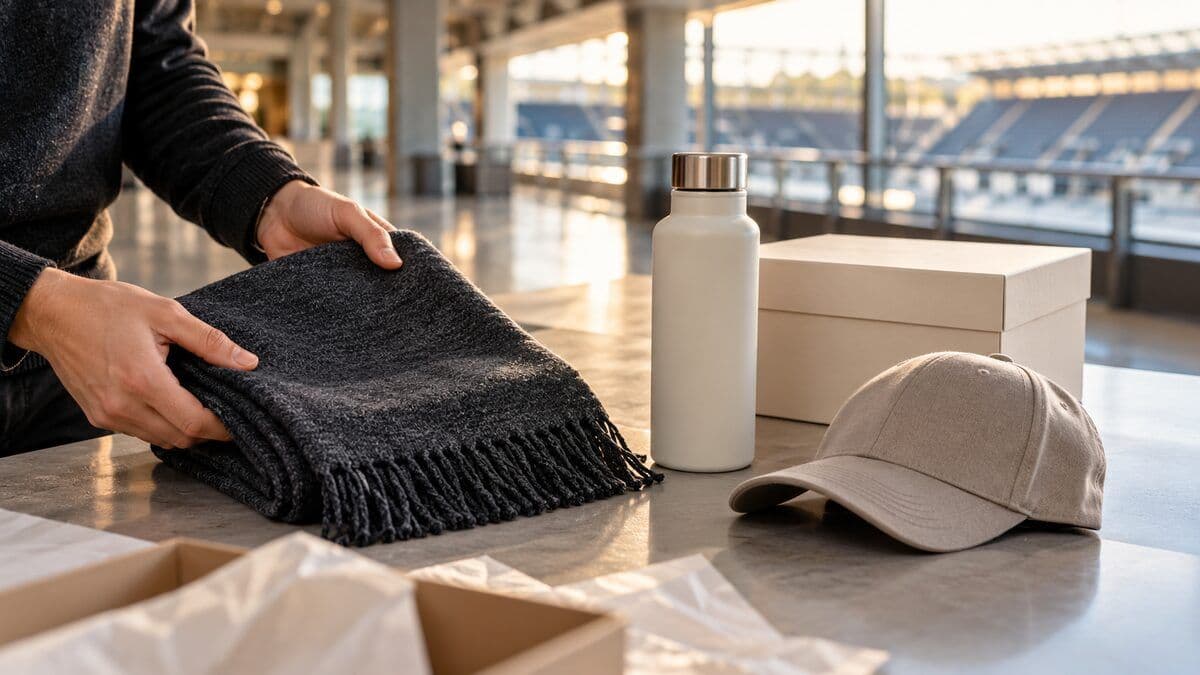


Sports-team gifting fails when a good-looking item is mistaken for a complete program. A staff milestone, sponsor activation, and fan promotion can all use merchandise, but they have different rights, recipient-data, approval, delivery, and recovery paths. This comparison gives commercial, partnership, and people-operations teams eight operating models and a procurement method that starts with the actual moment, not a preferred vendor. The examples are hypothetical planning exercises; prices, capacity, licensing scope, and service levels must be obtained in a current proposal.
Define the job before choosing the gift
Separate the recipient groups. Staff recognition is an employer program with eligibility, payroll and employee-data questions. A sponsor gift is part of a contracted commercial relationship and needs an account owner, hospitality rules, permitted marks, and a reliable arrival date. A fan promotion may be a consumer offer, sweepstakes, or game-day distribution with its own disclosures, venue rules, accessibility, volume, and safety review. A single catalog can supply all three, but it cannot make those decisions interchangeable.
Write one brief for each moment: audience and approximate count; purpose and success signal; approved monetary and per-recipient ceiling; countries and delivery methods; artwork owner; last acceptable arrival; personalization or choice; consent and address-collection route; returns and substitutions; and who signs acceptance. If the quantity is an estimate, specify a low, expected, and high case. Distinguish the date of the event from the date at which the team must stop accepting new recipients. That small distinction determines whether bulk stock or an invitation-based program is feasible.
Rights are a separate workstream. A team owning its own wordmark may still need review of a league mark, player image, photographer's work, sponsor logo, venue imagery, or co-branded layout. For a concrete example, the J.League's property guidance describes permissions for commercial uses of league property and player likenesses. It is evidence about that league, not a blanket rule for every competition. Record the exact approved artwork file, permitted items, territory, channel, dates, and approving party. A purchase order is not a rights grant.
Delivery rights matter too. The Detroit Tigers' ballpark guide describes venue-specific restrictions on unauthorized merchandise sales. A program that ships to homes, distributes in a private suite, or sells in a stadium may face three different operational approvals. The venue operator—not the gifting platform—must confirm loading dock, credential, security, prohibited-item, and distribution rules. Make that confirmation an acceptance gate before inventory is committed.
Eight models, compared on the same questions
This is a fit matrix, not a league table. The question is who owns rights, stock, recipient choice, delivery proof, and exceptions. “Best fit” describes the situation in which the model is worth quoting; it is not a tested performance score. Every supplier, including Giftpack, must answer the same procurement questions in writing.
| Operating model | Best-fit job | Control gained | Tradeoff and proof to request |
|---|---|---|---|
| Official team store | Recognizable licensed items for a small, domestic group | Existing official assortment and established retail checkout | Limited personalization or program reporting; confirm bulk terms, stock, pickup and returns |
| Local retailer | Short lead time near one venue | Local pickup and a human fallback | Fragmented inventory and rights evidence; obtain written substitution and invoice rules |
| Licensed merchandise vendor | Custom marks, collectible quality, or co-branded pieces | Specialist production and artwork workflow | Minimums, proof cycles and inventory exposure; inspect license scope and preproduction sample |
| Third-party logistics provider | Team already owns approved goods in volume | Warehousing, pick-pack and distribution processes | Another party must source and approve goods; require stock accuracy and scan-level exception reports |
| Print-on-demand partner | Small runs or designs with uncertain demand | Less finished-goods inventory | Unit cost, color consistency and deadlines vary; test an approved proof and actual delivery window |
| In-house kit room | Local, recurring staff moments with available labor | Direct oversight of packing and handoff | Hidden labor and peak-load risk; measure capacity, loss controls and backup cover |
| Digital choice or reward | Distributed recipients who value choice over a physical collectible | No event-day stock staging | Eligibility, redemption, tax and brand experience differ; inspect regional offer and expiration terms |
| Giftpack execution layer | Approved multi-audience or multi-region program needing catalog, choice and fulfillment coordination | Potentially one governed workflow across sourcing, invitations and delivery | Verify exact service scope, item rights, data flow, geography, fees and exception ownership in a proposal |
The official store is often an excellent answer when the purpose is simply to give a known, available, licensed product to twenty local guests. The Kansas City Royals' team-store page illustrates that an official store can have phone-order and pickup routes, subject to its current terms. Do not put a platform between buyer and store merely to look “enterprise.” Conversely, a store receipt may not provide recipient-level consent, multi-market address collection, or sponsor-specific reporting. Ask for those deliverables rather than assuming they exist.
The licensed vendor is the natural candidate when the object itself is the program: a high-spec anniversary garment or a co-branded commemorative item. Ask who owns the license relationship, whether the proposed use is within it, the sample-approval sequence, tolerance on colors and finishes, cancellation point, and who pays for rejected goods. A 3PL can then be useful for storage and distribution. The two are complementary, not alternatives on every line item.
Print-on-demand is useful when artwork is approved but demand is hard to predict. It does not remove rights review. An in-house kit room can be cheaper for a contained local cohort if staff hours, damaged stock, address handling, and event-week overtime are counted honestly. A digital reward is often kinder to a geographically dispersed recipient, yet it may be a poor substitute for a collectible a sponsor has promised to display. This is why the brief's purpose must precede the model.
Giftpack's published FAQ describes company stores, custom merchandise, warehousing, fulfillment, and recipient choice. Those are capabilities to verify against a specific scope, not evidence that Giftpack owns league marks, guarantees stadium admission, or decides employer policy. Compare its quote to the specialist and in-house options on the same recipient count, approved assortment, delivery cutoff, data-transfer method, support window, and exception log. If the program is only one box handed to one local sponsor, a simpler route may be better.
Make the procurement matrix executable
Use a single line per vendor and the same definitions of total cost. Quote product, customization, sampling, rights fees if applicable, inbound freight, storage, pick-pack, outbound postage, tax treatment as determined by the buyer, expected spoilage, returns, support, platform fees, and event rush charges. A “free” setup with a high minimum or overage can change the decision. Use ranges where the vendor has not confirmed quantities; do not convert an estimate into a claim of market price.
| Gate | Buyer input and owner | Evidence to retain | Fail or recovery rule |
|---|---|---|---|
| Audience and eligibility | People ops or partnership lead approves recipient class and value ceiling | Dated roster rule, not a circulating full roster | Pause invitations when eligibility conflicts; resolve with owner |
| Rights and artwork | Team brand and legal owners approve exact files and use | License or approval reference, proof version, permitted channel | Quarantine unapproved design; switch only to preapproved unbranded item |
| Quantity and finance | Program owner sets low/base/high demand and budget | Comparable all-in quote and change-order rule | Escalate overrun before production or top-up |
| Recipient data | Privacy owner approves collection, access and retention | Data-flow map, minimal fields, deletion route | Stop export on unexpected fields or destination |
| Venue and fulfillment | Venue operator and fulfillment lead approve route, cutoff and handoff | Written access plan, scan events and exception contact | Use preapproved home-ship or hold; no improvised entrance delivery |
| Acceptance and close | Named buyer checks count, condition, delivery and spend | Sample signoff, delivery exceptions, reconciliation | Issue credit/replacement decision under contracted terms |
Make every “yes” attributable to a person and version. A supplier presentation that shows an attractive mockup is not a signed rights file; a tracking number is not proof that an event team accepted cases; an invitation sent is not evidence that a recipient received a reward. The evidence can be proportionate to the program: a twenty-person staff thank-you needs less infrastructure than a six-country sponsor launch, but it still needs clear owners.
Set a decision point before artwork and money become hard to reverse. One workable sequence is: scope and rights feasibility; sample and landed quote; data and venue approval; purchase order; production inspection; delivery dry run; launch; exception window; final reconciliation. The buyer should define the last reversible step and the authorized substitute for each critical item. Ask vendors to show how they would handle a failed address, a missing carton, a print defect, and a late rights objection. Comparable answers are more useful than generic claims of “end-to-end” service.
Use the English procurement matrix (XLSX) to record current quotes, rights evidence, venue constraints, owners, and an exception path for each model. Its blank cost cells are deliberate: the conditional total formula does not turn missing quotes into estimates.
Hypothetical decision one: sponsor launch across two markets
Imagine a team promising 120 sponsor contacts a season-opening thank-you, split between a local hospitality event and remote offices. The objective is sponsor stewardship, not consumer reach. The partnership director owns the audience and contracts; the team brand manager owns mark use; a sponsor contact approves its own logo; finance approves the ceiling; privacy approves the invitation data flow; operations owns delivery. This is a hypothetical case, not a report of an actual team or Giftpack deployment.
Start by splitting the recipient route. Forty guests at the event could receive an approved collectible via the official team store or a licensed merchandise vendor with a venue-approved distribution plan. Eighty remote recipients could choose between an approved item and a non-logo alternative, provided the choice and geographic availability are confirmed. A 3PL or governed gifting platform may coordinate those remote shipments. A local retailer is an emergency fallback for an unbranded item, not an automatic substitute for promised co-branded goods.
The draft procurement sheet has three offers: official-store stock for the local forty; licensed production plus logistics for all 120; and a split program using approved stock plus recipient choice for remote contacts. Score none until the vendors return comparable evidence. Require a physical sample for bespoke merchandise, a rights approval reference for each mark, confirmed stock and lead time, a two-market landed-cost range, service windows, data fields and deletion route, and an owner for delivery exceptions. The partnership team may value uniformity; remote recipients may value choice. Record that tradeoff explicitly.
Suppose the co-branded proof arrives with a sponsor logo outside its approved clear space two weeks before launch. Do not “fix it in production.” Freeze that item, have the brand owners approve a corrected proof and revised date, and compare the revised timeline to the event cutoff. If it misses, switch the local guests to an already-approved team-store item only if the sponsor contract allows it; give remote recipients a preapproved unbranded choice or defer the invitation. Notify the commercial owner before promising a replacement. Acceptance is a signed sample, rights file, venue handoff, recipient-level delivery or redemption report appropriate to the channel, and finance reconciliation against the approved ceiling.
Cross-border shipments need a separate feasibility check for each destination: serviceability, delivery estimate, import responsibilities, recipient contact method and returns. A platform can coordinate tasks but cannot waive a destination's rules. Ask the supplier for specific routes and exceptions rather than asserting that “global” means every country or every item is available. For deeper operational design, the global gifting operations guide and recipient-data operations guide are useful internal companions.
Hypothetical decision two: staff season milestone
Imagine 650 staff members—front office, seasonal event workers, and remote scouts—reaching a season milestone. People operations wants equitable recognition without forcing everyone into the same physical size or delivery route. The program is hypothetical. People operations defines eligibility and the employment context; payroll/tax advisers determine treatment; brand approves artwork; finance sets the ceiling; privacy approves the data route; operations owns service and exception resolution. A vendor does not decide who is an employee or what value is reportable.
First separate cohorts without exposing unnecessary employee details to a merch supplier. A local kit-room handoff might serve front-office staff efficiently. An official store voucher or approved digital choice might work for people who prefer to select size or item. Remote scouts may need home delivery, but the team should confirm whether the address can be collected by invitation rather than exported from HR records. A controlled store or platform is valuable if it reduces duplicate orders and produces an auditable entitlement ledger; it is not automatically necessary for the local handoff.
Build an entitlement table with a unique internal identifier, approved option set, maximum value, redemption window, and status. Keep the HR eligibility file with the employer. Pass only the minimal claim or invitation fields needed by the chosen executor, under the approved arrangement. Define what happens when a seasonal contract ends, a person declines, or a parcel is returned. Finance should receive an aggregate and exception reconciliation rather than an unrestricted copy of personal addresses.
Test a small cohort before the entire 650. Include one local pickup, one remote address, one size exchange, one decline, one returned package, and one duplicate invitation. Confirm language and accessibility of recipient messages, stock reservation behavior, support ownership, and whether unused entitlements expire or are reallocated. A trial is not a claim that a vendor has passed; it is an acceptance method the buyer can run.
If a chosen cap size sells out after invitations, suppress only that option, preserve the person's entitlement, and offer a preapproved comparable item or a later shipping window. Do not silently substitute a lower-value product. If the kit room cannot pack the projected event-week volume, transfer only already-approved items to a prepared logistics route with a counted handoff. Acceptance is eligibility accuracy, correct item or informed choice, no duplicate redemption, exception resolution within the contracted window, and a final ledger tied to spend. The company-store operations guide covers stock and approvals, while the merchandise program guide goes deeper on inventory controls.
Rights, venue, and data checks that do not disappear at checkout
The phrase “official merchandise” answers only part of the question. It can indicate the retailer's product is licensed; it does not license a buyer to modify the item, add another sponsor mark, reproduce a player photograph, or resell it through an unapproved channel. Ask the rights owner or its authorized licensee about the exact proposed use. Keep approvals near the production proof so an outdated file cannot be reused after the event. Where the rights answer is pending, preserve a non-branded route instead of risking a rushed counterfeit-looking workaround.
Venue readiness is operationally specific. Confirm loading dates, security list, carton labels, dock appointment, storage, distribution zone, permitted people, accessibility, weather protection, waste removal, and who signs for inventory. For fan promotions, the team must also decide the offer mechanics and applicable rules with its own legal and venue owners. A last-minute delivery driver cannot infer authorization from an event ticket. The most valuable evidence is a named venue contact and a written handoff plan with a fallback address.
Recipient data deserves equal specificity. A sponsor may give the team a list of contacts, but the authority to use those contacts for gifting should be established by the buyer, not assumed by the executor. Collect only fields necessary for the chosen route; separate invitation from address collection where feasible; limit access; set deletion and return-handling rules. When a parcel fails, the support desk needs the relevant exception status, not the full sponsorship contract or an entire HR file. The buyer remains responsible for its legal, tax, payroll, privacy, employment and marketing decisions.
Quality is not only decoration. Confirm dimensions, material, fit, packaging, safety information, production tolerances, and the recipient's ability to use the item. If the gift is likely to be kept because it is useful, the decision still needs a valid source for any numerical claim about consumer behavior. PPAI's July 2026 consumer-study listing discusses usefulness, quality and relevance, but the underlying report is gated. This article does not infer its sample, percentages, or ranking. Use the criteria as buyer questions, and inspect a current sample.
Run a small acceptance test before committing the season
Take one intended scenario from each recipient class and walk it from approval to close. For staff, confirm eligibility and handoff; for sponsors, check marks and contractual expectations; for fans, test offer disclosures, queue management and venue permission. Send a real test order or controlled invitation where permitted. Check product, packaging, address collection, transactional messages, support contact, tracking, failed delivery, replacement and final invoice. Record the test date, location, item and version; a successful local test is not proof of cross-border capacity.
Ask each bidder for a responsibility map. The buyer's team signs the purpose, audience, rights, budget, policy and venue. The vendor commits only to the contracted scope: sourcing, production, storage, invitation, fulfillment, or support. The team should be able to identify one incident commander for an event-week exception and one person authorized to approve a substitute. If a provider cannot name the boundary between its obligations and the team's, pause selection until the proposal is clarified.
Use an acceptance checklist rather than a vague satisfaction survey:
-
The final rights-approved proof matches the produced item and the permitted channel.
-
The event or shipping cutoff, contact, and fallback route are written down.
-
Sample condition, sizes, packout and accessible recipient instructions have been checked.
-
Recipient data fields, access, retention and deletion match the buyer's approved plan.
-
Stock and order counts reconcile, with duplicate and unclaimed entitlements identified.
-
Failed deliveries, defects, returns and credits have named owners and dated decisions.
-
The final invoice separates product, production, freight, storage, service and exceptions.
What if approved licensed artwork is withdrawn after a purchase order?
Stop production or distribution of the affected version if the rights owner requires it; isolate the stock and retain the file/version and decision record. Ask the rights owner which uses, if any, remain permitted. Compare a corrected proof, an already-approved plain alternative, and postponement against the contractual promise and event cutoff. The commercial owner decides the recipient communication and cost change. A supplier may execute the chosen route but must not treat a prior approval as permission for a new artwork, channel, or date.
The decision packet should be short enough to sign: purpose, recipient groups, rights and venue status, comparable quotes, selected model or split model, data route, cost range, sample result, exceptions, and acceptance owners. Archive superseded artwork and price versions. A later program should reuse the decision process, not silently reuse an expired permission.
Conclusion: choose the model that survives the exception
There is no universal winner among these eight models. An official store or local retailer can be the simplest route for a contained, licensed local gift; a licensed producer plus logistics may be strongest for a collectible at scale; in-house packing can make sense when labor and stock controls are real; digital choice may serve dispersed recipients better than a fixed box. A coordinated platform earns its place when the buyer needs governed choice, multi-route fulfillment and visible exceptions. Choose on the same evidence, test the difficult route, and keep rights and employer decisions with their authorized owners.
For teams that have approved the audience, artwork, policy and venue route, Giftpack can be evaluated for merchandise, recipient choice and fulfillment execution. Request a scope-specific proposal and compare it with the simpler and specialist options above.