

Picture a Cleveland merchandise coordinator preparing an orientation kit with a notebook, bottle and language-specific welcome card. Every component is correct, but the packout instructions tell the operator to apply a destructive paper seal before checking the card. The mistake appears only when a supervisor has to break the seal to see the insert. Before training temporary packers, the coordinator needs to repair the order of work, not buy another checklist of components.

Use this gift kit assembly order checker to compare one supplied seven-step sequence with nine owner-approved prerequisites. It identifies invalid inputs and work placed after something that depends on it. It does not invent the right process, optimize a line or authorize production. Start with the filled example, test the failure cases, then have the packing lead approve a physical trial of the exact kit revision.
Define the kit before deciding its sequence
Freeze the product and packaging revision first. Identify the contents, quantities, card language, protection, closure and dispatch-label arrangement. An instruction to “inspect the kit” means little unless an operator knows which card version and item configuration should be present. If different kits need different actions, give them separate controlled procedures rather than asking one seven-step example to cover everything.
Walk through one physical assembly with the person responsible for packout. Name actions that can be observed: verify item identity, protect an item, load contents, inspect the contents and language, check fit, seal, label. Ask what information or access each action needs. A prerequisite is a declared requirement that one action must finish before another starts in this model. It is not simply a preference for how the worksheet should look.
The USPS domestic package-preparation guide supports using strong packaging, cushioning to limit movement and secure seams. It does not prescribe this checker or say that its formulas approve a gift kit. The inspection-before-seal relationship below is an expressly approved process dependency for the example, not a USPS rule. Carrier requirements and the suitability of the actual package remain separate checks.
Identify irreversible or costly-to-reverse operations during the walk-through. A destructive seal can hide an insert; a closed compartment can prevent an operator from checking an item. Put the required observation before the point where access disappears. If the protection or package itself is unsuitable, changing sequence alone cannot repair it. The lead must resolve the physical specification as well as the order.
Fill the seven steps with a unique position for each
The model fixes seven case-sensitive identifiers, A through G, to seven rows. Each step receives a different integer position from 1 through 7. The action names explain this particular kit; the identifiers connect those actions to the prerequisite list. Keep that connection visible when someone edits a description. A formula cannot tell that “inspect contents” has quietly been changed to an unrelated task.
| Step ID | Action for this kit | Declared position | Input check |
|---|---|---|---|
| A | Verify item identity | 1 | OK |
| B | Protect the individual item | 2 | OK |
| C | Load all contents | 3 | OK |
| D | Inspect contents and card language | 4 | OK |
| E | Check fit and movement | 5 | OK |
| F | Apply the irreversible seal | 6 | OK |
| G | Attach the dispatch label | 7 | OK |
The step table is filled for the reference sequence. Its OK entries mean the identifiers and positions satisfy the input rules. They do not establish that an operator performed the action or that the goods passed an inspection. Keep a separate trial record for those observations. A planned position and an execution sign-off answer different questions.
In a spreadsheet, place the identifiers in A2:A8, action descriptions in column B and positions in C2:C8. Column D checks the rows. Treat these addresses as the defined layout, not freely movable labels: the formulas use fixed ranges and derive expected identifiers from row numbers. If you redesign the layout or expand the number of tasks, the model and its tests need a controlled revision.
Approve the nine prerequisite relationships
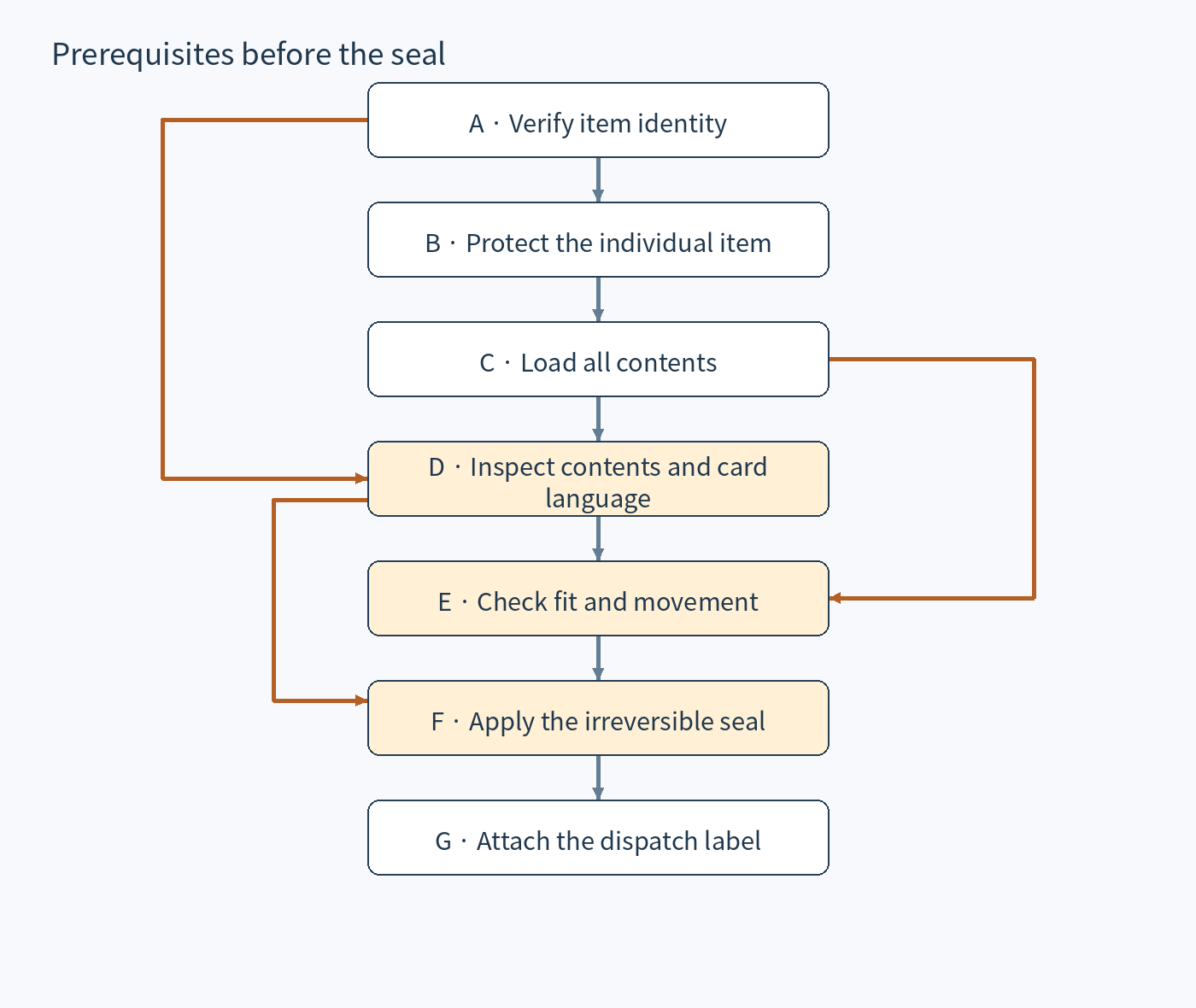
An arrow from A to B means A must precede B. The nine relationships include the obvious neighboring steps and three additional dependencies. A must precede the contents inspection; loading must precede the fit check; and the contents inspection must precede sealing. Those additional entries keep important requirements explicit rather than relying on a reader to infer them from the printed order.
| Prerequisite | Dependent step | Reason in this reference kit | Baseline result |
|---|---|---|---|
| A | B | Verify identity before protecting the item | OK |
| B | C | Protect the item before loading | OK |
| C | D | Load contents before checking the assembled contents | OK |
| D | E | Confirm contents and language before the final fit check | OK |
| E | F | Check fit and movement before sealing | OK |
| F | G | Seal before attaching the dispatch label | OK |
| A | D | Identify the item before approving its contents | OK |
| C | E | Load the contents before assessing fit | OK |
| D | F | Inspect the contents and language before losing access | OK |
Enter these nine pairs in F2:G10 and use column H for their checks. Preserve the approved list beside the trial input. A checker can reject a blank pair, unknown identifier or duplicate relationship, but it cannot recognize every wrong relationship that an authorized-looking editor supplies. Replacing a real prerequisite with a different valid pair can change the process without triggering an input error.
The lead therefore approves two things: which relationships belong in the model and whether the proposed positions satisfy them. Do not delete D→F to make an early seal pass. That removes the requirement rather than fixing the sequence. An apparently successful result with an incomplete dependency list is not evidence that the kit's actual work has been covered.
Read the three outcomes as instructions for the next review
INVALID means at least one input row violates the defined rules. Correct that problem before interpreting order results. REORDER means the entered data passes the input checks but at least one declared prerequisite does not occur earlier than its dependent step. ORDER VALID means the supplied positions satisfy this declared relationship set. None of these codes grants permission to execute the process.
For readers and operators, display the codes with plain explanations: Invalid input, Revise sequence and Declared order valid. Retain the stable codes for comparisons and fixtures. Show the affected row and explanation, rather than relying on a red or green cell. A person reviewing a printed sheet should be able to identify the missing input or reversed relationship without seeing its color.
The comparison is strict: a prerequisite position must be less than the dependent position. Equal positions are not simultaneous approval. The step rules also require unique positions, so two checks both entered as position 4 make the overall input invalid. If work can genuinely run in parallel, this fixed sequential model does not describe that arrangement; change the model deliberately rather than pretending a duplicate rank has new meaning.
Use the formulas without weakening their input guards
The step formula below belongs in D2 and is copied through D8. It requires the literal uppercase identifier expected in that row, a numeric nonlogical integer within range, and a position used only once. The formula distinguishes a numeric 4 from the text “4.” Keep the EXACT and IFERROR guards when transferring it into the defined layout.
=IFERROR(IF(AND(EXACT(A2,CHAR(ROW()+63)),ISNUMBER(C2),NOT(ISLOGICAL(C2)),C2=INT(C2),C2>=1,C2<=7,COUNTIF($C$2:$C$8,C2)=1),"OK","INVALID"),"INVALID")
Place the relationship formula in H2 and copy it through H10. It restricts both identifiers to one uppercase letter A–G, rejects a self-reference and requires each exact ordered pair to occur once. Only then does it compare the two positions. The duplicate test uses literal matching so wildcard-looking text cannot act as an identifier pattern.
=IFERROR(IF(OR(LEN(F2)<>1,LEN(G2)<>1,CODE(F2)<65,CODE(F2)>71,CODE(G2)<65,CODE(G2)>71,EXACT(F2,G2),SUMPRODUCT(--EXACT($F$2:$F$10,F2),--EXACT($G$2:$G$10,G2))<>1),"INVALID",IF(INDEX($C$2:$C$8,CODE(F2)-64)<INDEX($C$2:$C$8,CODE(G2)-64),"OK","ORDER")),"INVALID")
K2 summarizes the row results. Input invalidity takes precedence over relationship-order failures. This prevents a reviewer from treating a partial set of plausible comparisons as a valid sequence while another required field remains invalid.
=IF(COUNTIF(D2:D8,"INVALID")+COUNTIF(H2:H10,"INVALID")>0,"INVALID",IF(COUNTIF(H2:H10,"ORDER")>0,"REORDER","ORDER VALID"))
These are the accepted reference formulas, not a claim that a downloadable workbook has already been recalculated in Excel or Calc. Verify them in the final native file and test changed inputs there. Cached values that merely reproduce a saved example cannot establish that edits trigger correct calculation. Preserve the formula text and expected fixtures when checking spreadsheet compatibility.
Cleveland decision: repair three reversed relationships before 240 kits
Assume the coordinator plans 240 orientation kits using the reference components and an already approved packaging specification. A draft procedure assigns positions A–G as 1, 2, 3, 6, 5, 4, 7. That places sealing F at 4, fit check E at 5 and contents inspection D at 6. All seven positions are unique integers, so this is an order problem rather than an input-type problem.
For D→E, the comparison is 6<5, which is false. For E→F it is 5<4, also false. For D→F it is 6<4, again false. Those three relationship rows return ORDER, and K2 returns REORDER. The remaining six relationships are satisfied. Count the failures as three relationships, not three defective kits or a forecast of how often packers will make mistakes.
The lead restores D, E and F to positions 4, 5 and 6. The comparisons become 4<5, 5<6 and 4<6. With the other inputs unchanged, all nine relationships are OK and the result is ORDER VALID. The next action is a supervised physical trial: verify that the loaded contents and correct card remain visible at D, perform E without invalidating D's inspection, then apply the seal.
To examine training capacity, assume a supervisor allows 12 minutes to demonstrate and discuss each of the seven actions. The allowance is 7×12=84 minutes. Two supervised complete trials at eight minutes each add 16 minutes, for 100 minutes total. A 90-minute training window is ten minutes short under those assumptions. Adjust the session or its scope explicitly; do not eliminate the inspection to make the schedule fit.
Those times are planning inputs, not measured cycle times or proof that 240 kits can be completed at a particular rate. The trial may reveal that an action needs different wording, equipment or protection. If the physical sequence changes, update its revision and rerun the checks before teaching the new version. A valid worksheet cannot compensate for instructions an operator cannot carry out.
Boston decision: two checks cannot share position four
For a 60-kit donor-event variant, assume the owner retains both contents inspection D and fit check E. Someone enters A–G as 1, 2, 3, 4, 4, 6, 7, describing the two checks as simultaneous. Positions D and E both equal 4, so each fails the unique-position rule. The overall result is INVALID even if several relationship comparisons still look sensible.
Restore the defined sequential positions, with D=4 and E=5, while keeping D→E and D→F. Do not remove a relationship to disguise a duplicate position. If the team truly needs independent parallel checks, it must specify how their completion gates sealing and approve a different representation. This checker validates one supplied sequence of seven distinct positions; it does not schedule parallel resources.
Assume a proposed additional preseal verification takes 20 seconds per kit. Across 60 kits, that is 1,200 seconds, or 20 minutes. If only 15 minutes are allocated, the allowance is 900 seconds, or 15 seconds per kit. The plan is five seconds per kit short, totaling 300 seconds or five minutes. These are workload assumptions for the decision, not an observed inspection speed.
The owner can allocate more time, simplify an approved operation after review, or change the packout plan. A favorable time estimate does not justify losing either required check. After unique positions and relationships pass, confirm on the real variant that the contents, card and fit can be assessed before closure. Record the variant's own procedure version rather than treating every change as covered by the orientation kit's trial.
Test bad inputs and contradictory relationships deliberately
Keep the baseline A–G positions 1 through 7 and the nine approved pairs as the starting fixture. Its expected result is ORDER VALID, with seven OK step rows and nine OK relationships. The Cleveland positions 1,2,3,6,5,4,7 must produce REORDER and the three failures described above. The Boston duplicate position must produce INVALID. Restore the baseline between independent mutations so one error does not hide another.
Test a blank position, TRUE, a fractional 2.5 and text “4”; each must produce INVALID. Test a lowercase step identifier a, wildcard text A*, a duplicate identifier A and an error-valued input; these also require INVALID. The rule is about exact identifiers and numeric positions, not text that looks approximately right. Confirm that an error remains contained by the defined guards instead of breaking the summary.
For relationship inputs, test A→Z, a duplicate pair and D→D. Each must be INVALID. Leave one of the nine relationship rows blank and confirm invalidity. These tests check the supplied grid's boundaries. They do not establish that the nine chosen relationships include every action needed for an unfamiliar product.
For the contradiction fixture, replace A→D with G→A while retaining the other eight pairs and baseline positions. The chain from A through G now returns to A. G→A compares 7<1 and returns ORDER; the summary is REORDER. The model does not label this a cycle or generate an alternative order. No renumbering can satisfy that loop. The lead must resolve the contradictory requirements and approve the corrected relationship list.
Accept the procedure with a physical trial and controlled handoff
Acceptance needs zero invalid rows, zero ORDER relationships, a complete owner-approved prerequisite set and a supervised trial of the exact configuration. Keep the trial date, procedure revision, participant roles, observed checks and unresolved issues. An ORDER VALID code without that evidence is only a result about the entered order. It is not a completed quality inspection or a production-release signature.
Compare the controlled card and artwork versions during the trial. The published Giftpack artwork-file guide explains the relationship between source artwork, production files and approved proofs. Use that discipline to identify what the contents inspection should compare. The sequence checker cannot discover that a perfectly timed inspection uses the wrong approved-looking card.
If an operator must open protection after D to complete E, ask whether that changes what D established. The owner may need another check or a revised action definition. Resolve that question before freezing the instruction. Do not add an eighth action informally while leaving the seven-row checker unchanged. Expanded work requires a revised model, ranges, fixtures and acceptance evidence.
Keep safety, accessibility, liquid containment, hazardous materials, temperature control and carrier acceptance under their appropriate procedures. The checker does not validate those requirements or a package's impact resistance. A trial can expose practical problems, but it should not be called a transport test unless the relevant evaluation was actually performed. Recheck physical requirements when products, packaging or the carrier route change.
Keep the workbook's scope visible
Download the English assembly order checker (.xlsx)
Organize a working copy into five sheets: Instructions, Steps, Dependencies, Fixtures and Sources. Use Instructions to identify the kit revision, permitted inputs and three outcome codes. Keep the live calculations on Steps at the addresses given above. Use Dependencies for the approved relationship inventory and its physical reasons, so the lead can compare that inventory with F2:G10 without maintaining a second set of calculations. Fixtures and Sources preserve the expected checks and the basis for the procedure.
Keep the operator's next action visible beside each result. An invalid position needs correction; a reversed relationship needs a revised sequence; a valid declared order still needs the approved physical trial. When handing a copy to another lead, identify the person responsible for maintaining its specification and the date of the last review. Separate editable input cells from formulas, and retain an unchanged baseline for comparison. A translated instruction or reformatted sheet should preserve the same identifiers, ranges, expected results and approval boundaries.
Before using any completed file, confirm its revision and which inputs may change. A deleted task, a wrong replacement relationship or a new seal can alter the real process while leaving syntactically valid data. The packing lead owns specification and carrier-change review; the source notes should also have a periodic editorial review. Preserve the approved baseline so later users can distinguish a corrected order from an unapproved change in requirements.
Bring Giftpack the approved packing sequence and its limits
Take the approved kit specification, artwork, relationship list, trial record, quantities and required date to Giftpack's custom merchandise team. Ask how sourcing, sampling, production, packing and delivery fit the actual project. Explain which checks must remain visible before the irreversible seal and identify who may approve a material, artwork or process change.
The Giftpack Help Center describes item-dependent samples or proofs and quality checks against agreed requirements. Confirm the contracted scope and responsibilities; the service is not the source of this model or an automatic approver of assembly, safety or carrier suitability. The Cleveland coordinator can then train from a repaired sequence, while the Boston lead retains both checks and a realistic time allowance. In each case, the useful handoff is a dated, approved procedure supported by a physical trial, not merely a green spreadsheet cell.