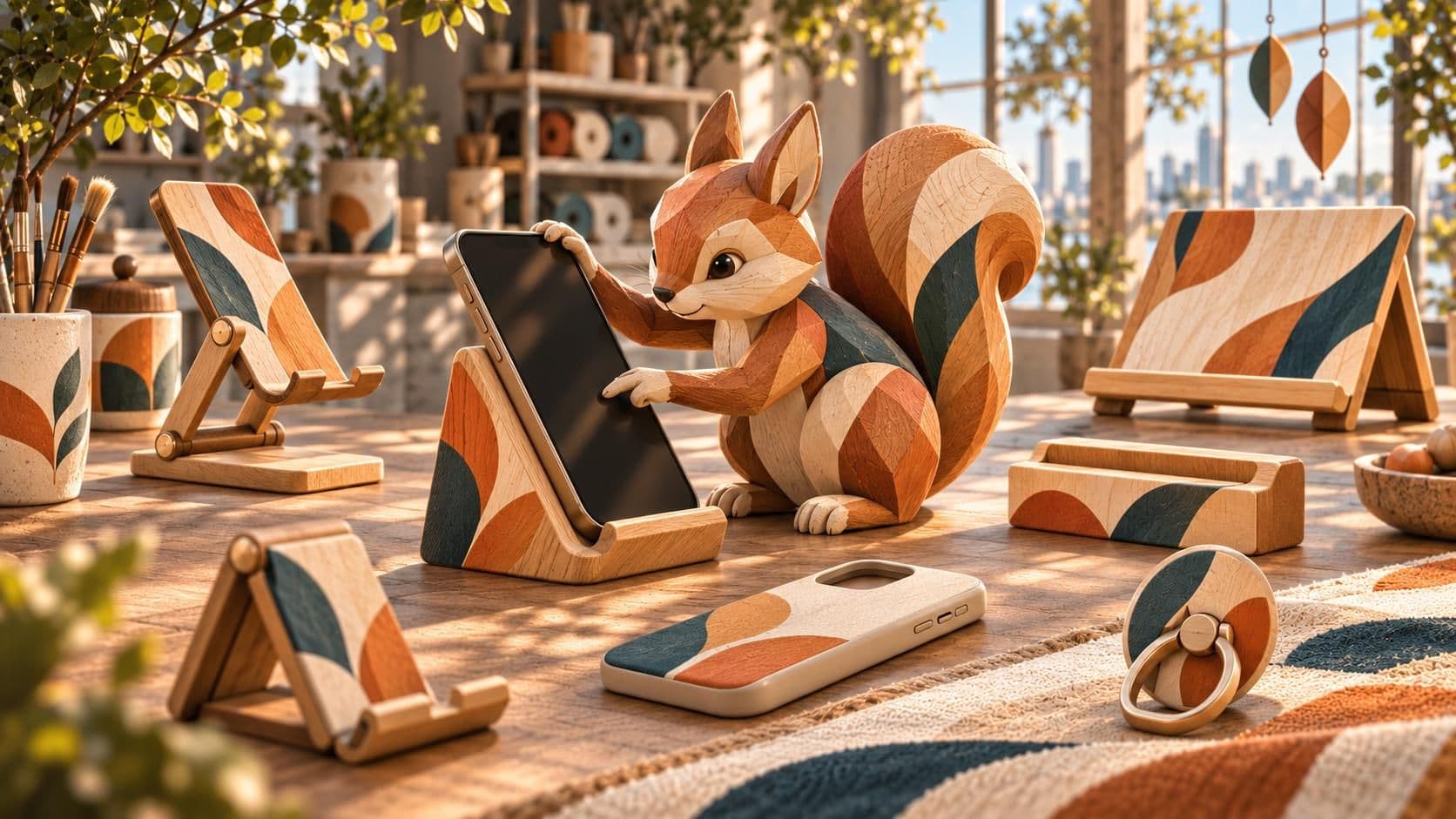

Imagine the last welcome-kit review before a 180-person order. An engraved bamboo holder looks right beside the notebook and badge. Then someone places a phone in a thick protective case into its slot. The case rests across the opening instead of seating inside it. There is still time to change the holder, but approving it by screen size alone would send the problem to every recipient with a similar case.
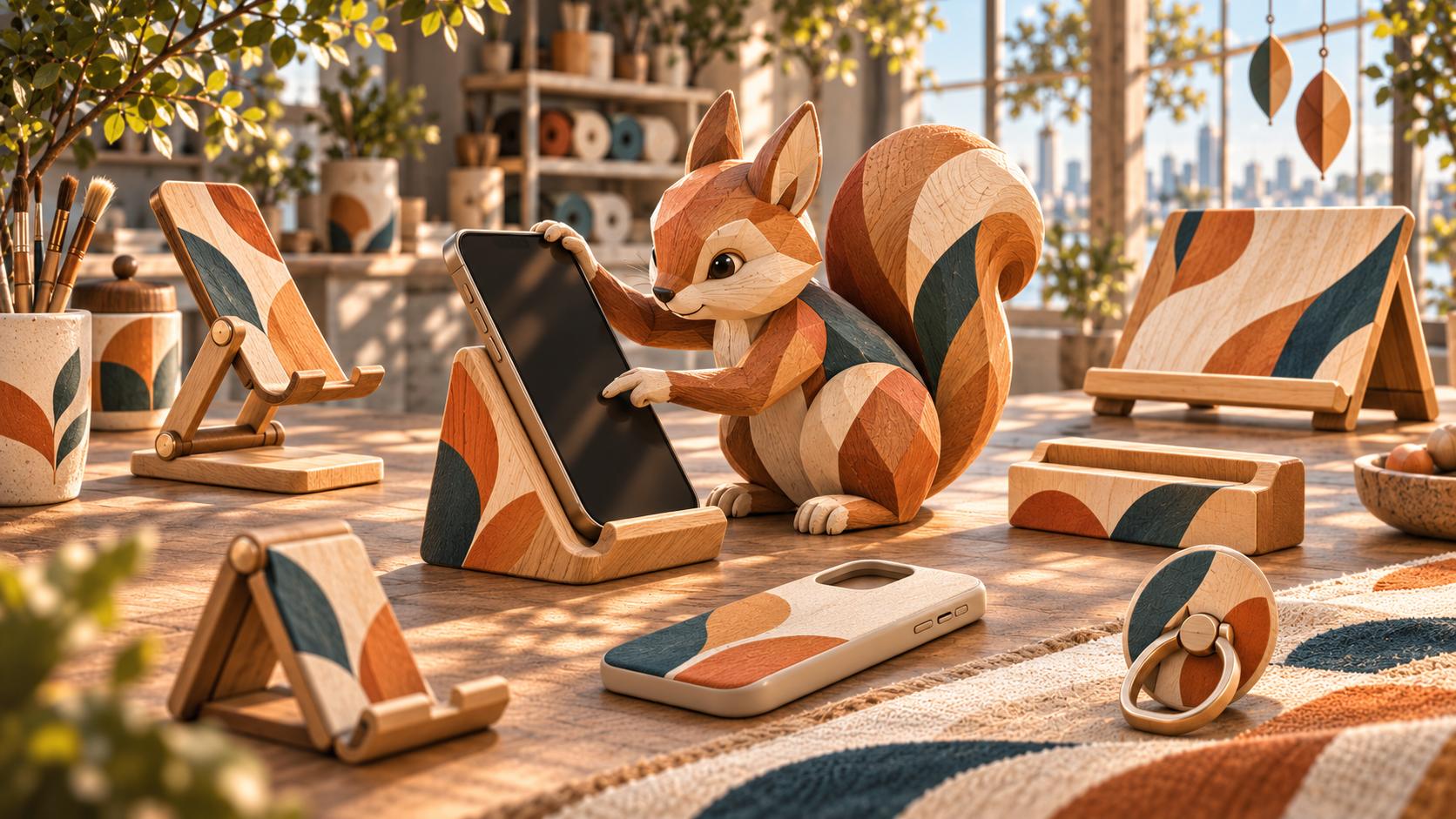
For employee-experience teams, that is the central question behind phone stand corporate gifts: can people use the gift with the phone, case and desk they already have? A pleasing material and a clean logo matter after the support mechanism works. Start with how the phone sits, how it moves between orientations and how the recipient takes it away.
This comparison covers six noncharging formats. They support a device without supplying power. Some allow a separate cable to pass through; that does not turn the stand into a charger. The product references illustrate mechanisms available in the market, rather than a ranking or a promise that those products can be customized for your program.
Define the phone task before choosing the material
“Hold a phone at work” leaves several important choices unanswered. A person reading a reference page beside a computer may need portrait orientation and easy pickup. Someone watching a training video may prefer landscape. A rotating-desk employee has to pack the holder at the end of the day. A recipient with an assigned desk may leave it in place but need room for papers in front of it.
Describe one primary task in a sentence: “Keep a case-on phone beside the monitor for reference reading, then let the user pick it up with one hand.” That sentence provides something to inspect. A request for a premium metal accessory provides much less direction about whether the product will work.
Collect the minimum useful device information: case-on thickness at the support point, phone width and length, rear-camera projection, any attached grip or wallet, and the required orientation. If a supplier provides a mass limit, include the complete device-and-case mass in the comparison. A screen diagonal does not describe a bulky bumper, a raised camera surround or a folding phone's changing geometry.
Ask about the workplace too. Can employees attach accessories to furniture? Is the desk edge square, curved or covered by a modesty panel? Does the stand need to fit a locker or kit insert? Can recipients use their personal phone for the proposed task at all? Resolving those questions early can remove a format before anyone spends time positioning a logo.
Compare six physical support routes
The following matrix is a first screening tool. Its rejection questions help narrow samples; they do not establish compatibility for an entire employee population.
Six noncharging phone-stand routes, compared by the information needed before sampling.
| Physical route | Useful job | Required input | First rejection question |
|---|---|---|---|
| Fixed slot block | Leave a phone at one viewing angle | Case-on thickness, slot opening, seating depth | Does it seat without wedging or hiding the screen? |
| Fixed raised cradle | Repeatedly pick up and replace a phone | Lip depth, camera projection, base footprint | Does ordinary tapping tip or slide the sample? |
| Folding easel or card stand | Carry a compact holder between desks | Folded envelope, deployment sequence, contact points | Can the user deploy it without improvising a support? |
| Articulated or telescoping pedestal | Adjust height and angle for a defined task | Case-on mass, extension, hinge position | Does the intended extended setting remain usable? |
| Desk-edge clamp with mechanical holder | Keep the support base off the working surface | Desk profile, attachment permission, phone controls | Can it attach without damage or pressing buttons? |
| Noncharging magnetic stand | Place and rotate a compatible phone quickly | Phone and case compatibility, ring conditions | Does the exact combination hold and detach as intended? |
1. Fixed slot block: inspect the opening, not just the footprint
A slotted block has a simple interaction: place the phone's edge into a groove and lean it against the support. IKEA's BERGENES illustrates this route with a bamboo body and two slot sizes. IKEA describes compatibility with most devices; that wording does not establish fit for every protective case.
Check the usable opening with the finished surface and any liner in place. A case can enter at the top yet stop before it reaches the intended support depth. A rear-camera surround may also change the resting angle. Inspect portrait and landscape separately: rotating the device changes which edge touches the slot and where the case protrudes.
This format is worth considering when one fixed view suits the task and the represented cases seat properly. Reject a sample that requires force or routine case removal when the brief requires case-on use. A larger block does not necessarily have a larger usable groove.
2. Fixed raised cradle: make pickup part of the comparison
A fixed cradle holds the phone against a backrest with a lip below it. Compared with a narrow slot, an open cradle can make the support surfaces easier to see. Its suitability still depends on the specific lip, backrest and base geometry.
Look at what the lip covers. The lower screen area, microphone openings and the user's swipe path may matter to the chosen task. Check whether a protruding camera makes the phone rock against the backrest. Ask the user to place, tap and remove the phone naturally; a stand that follows the phone across the desk during pickup needs a different configuration or candidate.
Choose a fixed cradle when a repeatable viewing position and uncomplicated placement serve the program. Do not infer stability from a heavy-looking base in a photograph. Evaluate the finished sample on a surface representative of the desks where it will be used.
3. Folding easel or card stand: include the deployment steps
A folding format trades a permanent footprint for a setup action. Nite Ize's QuikStand is a concrete example: the manufacturer describes a flat, approximately credit-card-size resting form, an adjustable support bar and a front flap. Its instructions require users to release the support, raise it and position the device.
That sequence belongs in your evaluation. Give a sample and the supplied instructions to someone who has not watched the buyer demonstrate it. Can they identify the front, deploy the support and seat the case-on phone? Can they fold it again without trapping a loose insert or forcing a hinge?
For daily carrying, examine the folded object as well as the deployed one. A compact outline is useful only if projecting parts, the instruction card and any protective sleeve fit the actual kit. Avoid promising wallet fit for a different folding product merely because another example uses that description.
4. Articulated or telescoping pedestal: approve a configuration
Pedestals add height, angle adjustment or both. SANWA's smartphone-stand lineup separates features such as angle adjustment, height adjustment, rotation and folding. That distinction is useful: a rotating base does not automatically provide more height, and folding does not describe how a hinge behaves in use.
Evaluate the position the task actually needs. Raising the device or moving it farther from the base changes the support arrangement. The highest advertised setting is not automatically the right setting for an employee's phone and task. Check the proposed angle and extension with the represented case-on device, then repeat normal taps and pickup.
If a lower setting works, approval can be limited to that configuration, provided it still serves the task and the restriction is practical to communicate. If users would immediately extend the stand beyond the approved position to see the screen, a restricted approval solves little. Choose another sample or another mechanism.
5. Desk-edge clamp and mechanical holder: permission comes first
A clamp fixes the support to an edge while a separate mechanical holder grips the phone. SANWA Direct's 200-STN044CB provides an official example of a folding clamp-mounted phone holder. Use the exact candidate's current instructions and specifications for its attachment limits; the format name supplies none of those limits.
First establish permission to attach it. Then inspect the complete desk edge, including underside clearance and surface finish. A nominal desktop thickness is insufficient if a rail blocks the clamp. Protective pads also need to remain where the manufacturer intends.
On the phone side, identify where the jaws land in both orientations. They must not operate side buttons or interfere with the intended action. This route can be a sensible sample candidate for an approved workstation, but it is a poor default for a mixed population whose desks and attachment permissions are unknown.
6. Noncharging magnetic stand: disclose the compatibility route
Magnetic support and wireless charging are different functions. UGREEN's official desktop-stand catalogue lists magnetic stand formats, including LP962. The catalogue establishes the mechanism's presence; it does not establish compatibility with every US recipient's phone or the terms of a branded gift order.
For a proposed magnetic product, obtain its exact phone-and-case requirements. Some combinations may depend on a compatible case; others may require an adhesive ring. Identify that ring as part of the delivered system before sample approval. Ask which surfaces it can attach to, how it is positioned, what preparation is required and what limitations apply after attachment.
Test placement, rotation and removal with the intended case and any required ring installed according to the supplier's instructions. Retain the supplier's warnings. A stand having no power supply does not make every magnetic accessory suitable for every recipient or environment. Keep a nonmagnetic choice available for people who cannot or do not want to use that arrangement.
Worked decision: a 180-person rotating-desk welcome kit
Return to the welcome-kit review. Assume this US employer permits freestanding desk objects but prohibits furniture attachments. Employees pack their desk items daily. The organizer wants one main stand option plus an exception route for unknown or incompatible cases. These are planning assumptions, not results from a completed rollout.
The clamp leaves the shortlist immediately because it conflicts with the furniture rule. The engraved slot block remains eligible only for cases that seat correctly; its appearance cannot override the opening problem. Compare a folding easel with a folding pedestal using the actual case-on phones and packed samples.
Assume the available insert cavity measures 120 mm × 95 mm × 25 mm. The packaging designer requests 2 mm of clearance on each opposing side. Subtracting 4 mm from each cavity dimension gives a maximum sample envelope of 116 mm × 91 mm × 21 mm in that orientation. This is a packaging assumption to verify, not a published stand specification.
Suppose candidate A's finished, sleeved folding sample measures 100 mm × 70 mm × 12 mm. Its remaining space is 16 mm in length, 21 mm in width and 9 mm in thickness against that envelope. Suppose candidate B measures 105 mm × 84 mm × 36 mm. It exceeds the 21 mm thickness allowance by 15 mm: 36 − 21 = 15 mm. Candidate B needs a redesigned insert or a different box. Compressing the lid onto its hinge is not an acceptable packing solution.
Now consider device uncertainty. If 150 of 180 employees provide usable case information, the unresolved group is 180 − 150 = 30 people, or 30 ÷ 180 × 100 = 16.7% of recipients, rounded to one decimal place. Those 30 people must remain unresolved in the order plan. They are not evidence that a “most phones” claim covers the rest of the population.
Conditionally shortlist candidate A if it also deploys reliably, supports the represented cases in the required orientations and allows ordinary pickup. Send the unresolved group through a short fit-selection or alternative-gift route. Do not automatically buy 180 identical units because the sample fits the box. The slot block from the opening either earns a defined case-compatible audience or leaves this program; the original seating problem is resolved before the kit order.
Worked decision: 48 assigned desks and reference reading
Assume a second team has 48 assigned desks and wants to glance at reference material on a phone while entering data on a computer. They do not need a travel format. The shortlist is a fixed raised cradle and an adjustable pedestal. The purchasing question is whether height adjustment improves access to the required view without creating an awkward placement or pickup action.
Start with the heaviest represented case-on device and the intended angle. Suppose its measured mass is 0.280 kg. In a simplified comparison, the center of that device is horizontally 40 mm from a selected reference point in the lower arrangement and 90 mm away in the proposed extended arrangement. Convert those distances to 0.040 m and 0.090 m.
Using 9.81 m/s² for gravitational acceleration, the device's weight is 0.280 kg × 9.81 m/s² = 2.75 N, rounded. Its moment about that reference point is approximately 2.75 N × 0.040 m = 0.110 N·m in the first arrangement and 2.75 N × 0.090 m = 0.248 N·m in the second. The second device contribution is 90 ÷ 40 = 2.25 times the first.
This arithmetic explains why configuration matters. It does not predict whether the whole stand will tip: the stand's mass, base geometry, contact conditions, hinge behavior and touch forces are missing. Nor does increasing height alone necessarily create the assumed horizontal displacement. Measure the geometry of the actual sample rather than assigning these example distances to a catalogue product.
Place both candidates at the intended desks. Ask representative users to read the reference, tap relevant controls and pick up the phone as they normally would. Record the exact extension, orientation, case and surface, with photographs of the support position. If the extended pedestal moves during the required action but a lower position is satisfactory, check whether that lower position still gives the needed view.
Approve the lower configuration only if it remains useful and its limits are clear. Otherwise choose the fixed cradle or request another sample. A successful desk demonstration supports that documented combination; it does not establish an ergonomic benefit or prove compatibility for all 48 devices. Recipients whose cases differ materially still need the exception route.
Approve the decorated sample through the whole use sequence
Decoration can change a sample's contact surfaces, appearance and packing. Mark the logo area on a drawing, then review the finished object. Keep artwork away from pads, hinge interfaces, the slot opening, phone contact points and retained instructions unless the supplier has specifically approved the treatment there. Confirm that the logo remains visible in the intended orientation without moving the phone into a worse position.
Use a repeatable sequence for each approved phone-and-case combination:
- Identify the exact stand SKU, revision, finish, pads and included accessories. Match them to the supplier's current instructions.
- Deploy or attach the stand as instructed, using the intended desk surface and any required permission.
- Place the case-on device in each required orientation. Confirm seating, screen visibility and access to the controls needed for the task.
- Perform ordinary task actions, including tapping, rotating where supported and removing the device. Record interference, movement and any need to hold the base.
- Fold or dismantle it if daily packing is required. Pack the decorated sample, instructions and accessories into the final insert, then close the box normally.
- Record the accepted combination and any restrictions. Keep the physical reference sample and photographs associated with that version.
Define acceptance in observable terms. “The specified case seats at the intended depth without force” is more useful than “good fit.” “Pickup does not lift the stand in the agreed demonstration” is more useful than “stable.” Set any numerical movement allowance with the supplier and the task owner before evaluating production evidence; do not invent a universal tolerance for every stand type.
A replacement hinge, different pad, revised ring, altered slot or moved logo can affect the earlier result. Reopen the relevant checks when those details change. The accepted sample should describe what may be supplied, rather than becoming a decorative reference that production can quietly depart from.
Keep exceptions visible in the order
A mixed personal-phone population rarely stays still. People replace cases, attach wallets or bring a different device after onboarding. Explain the accepted envelope and offer an alternative when the recipient's setup falls outside it. An opt-out can be more useful than asking someone to remove a protective case to accommodate a gift.
Handle foldable phones, attached grips, unusual camera surrounds and unknown magnetic compatibility as explicit questions. A supplier may have a suitable option, but that answer belongs to the exact combination. Do not extrapolate from a bare phone or another employee's case. Likewise, do not tell a recipient to add an adhesive ring without first disclosing that installation requirement and its supplier limitations.
Before placing the order, distinguish the main quantity, exception quantity and unresolved quantity. Assign someone to answer recipient fit questions and agree how substitutions will be approved. Confirm the actual decorated sample, packaging and delivery schedule with the supplier. A retail listing's price or availability is not a quotation for your logo, quantity, packing and delivery date.
The result is a usable selection: a mechanism matched to a task, an accepted case envelope, an approved sample and a route for people it does not serve. Material and decoration can then reinforce the gift instead of concealing an unresolved fit problem.
To carry the approved sample into the purchase order and receiving plan, use the corporate gift product specification and acceptance guide to record which material, artwork, packaging and functional conditions became binding for this order.
Bring a defined phone-stand brief to Giftpack
Once you have a preferred mechanism, bring that decision to Giftpack's custom swag and branded merchandise team. Giftpack's page describes developing product and packaging concepts before sampling, followed by production and delivery. Use that sourcing conversation to confirm which stand options are available for your particular program and who owns each approval.
Share the audience size, US delivery locations, intended phone task, case envelope, desk restrictions and packing dimensions. Include the sample questions that remain open, the proposed logo location and the exception route. Ask for the exact product version, decoration method, included instructions, sampling plan and project-specific commercial terms.
Giftpack is the sourcing conversation here, rather than a seventh stand mechanism or a certification of every phone-and-case pairing. Keeping the physical decision explicit gives the team a concrete brief to quote and sample. The welcome kit is ready to proceed when the phone seats, the user can complete the intended action and the finished stand fits its box.