


A corporate gifting dashboard becomes useful when its numbers can survive a finance review. Build your Microsoft Power BI model around distinct business events, accountable source owners and explicit reconciliation rules. A gift invitation, a completed selection, a supplier invoice and a refund are different facts. Combining them into one total called “spend” produces attractive charts and unreliable decisions. This guide shows how to keep those facts separate while giving procurement, finance and program operators a shared analytical view.

Decide what the model is allowed to answer
Start with three questions: what have we committed, what has happened operationally, and what has finance recorded? Give each question a separate measure family. The model should explain differences between them, not force equality by deleting inconvenient records. An approved commitment might precede a shipment by weeks; a refund request might never become a posted credit. Neither timing difference is automatically an error.
Write a one-page analytical charter before connecting data. Name the legal entities, programs, transaction currencies, reporting currency, reporting periods and permitted audiences. Finance owns the meaning of posted cost and the approved exchange-rate policy. Operations owns send and redemption definitions. The analytics owner owns transformations, refresh monitoring and reproducible calculations. A security owner approves access paths. One person can hold several roles, but the decisions must remain identifiable.
The boundary matters: this model is an analytical layer, not the accounting ledger or a payment approval system. It must not create accounting entries, infer tax treatment, release gifts or turn an operational status into a recognized expense. Use your approved finance system as the authority for posted amounts. Record disagreements in a reconciliation queue with an owner and resolution evidence.
For broader outcome selection, use the corporate gifting measurement framework. This guide addresses implementation mechanics: row grain, source lineage, measures, access and tie-out. It does not promise a downloadable model or a prebuilt connector. The architecture and examples below are original design recommendations, not a claim that they were deployed in your tenant.
Build a source contract before importing rows
Inventory sources by business authority rather than by convenient file format. Approved purchasing records supply commitments and changes. The gifting execution source supplies invitations and completed selections. Approved finance records supply invoices, credits and other posted lines. The program owner supplies outcome observations with their observation window. Treasury or finance supplies the approved rate table. A supplier export is evidence of the supplier's view, not automatically the accounting truth.
For each feed, agree on a stable source identifier, extraction timestamp, business event timestamp, source timezone, legal entity, program key, currency, status and deletion or correction behavior. Document whether a delivery is a complete snapshot or only changes since a watermark. Treat a file with a missing column as a failed contract, not a successful refresh with silent blanks. Keep source extracts in a controlled location with an approved retention policy.
Ask what “send” means in this particular program. This article uses an invitation successfully dispatched by the execution system, not a physical parcel or an email opened by a recipient. If your decision concerns shipment, create a separate shipment fact and label it accordingly. Likewise, define redemption as a completed gift selection for the examples here; do not silently substitute card spending or delivery confirmation.
Choose ingestion by risk. A controlled export can be adequate for a small monthly program if an owner checks completeness and protects the file. An authorized integration is better when volume and correction frequency make manual control fragile. A governed warehouse is preferable when several systems must preserve history. None of these options fixes missing identifiers. Confirm available fields and access with the actual provider before committing to an implementation estimate.
Keep one grain per fact and shared dimensions around it
The official star-schema guidance separates descriptive dimensions from facts with consistent grain. Apply that principle literally: write a sentence beginning “one row per” for every table before defining relationships. A finance fact can contain one row per posted source line. A send fact can contain one row per deduplicated invitation. A redemption fact can contain one row per completed selection. A commitment snapshot can contain one row per commitment line per snapshot date.
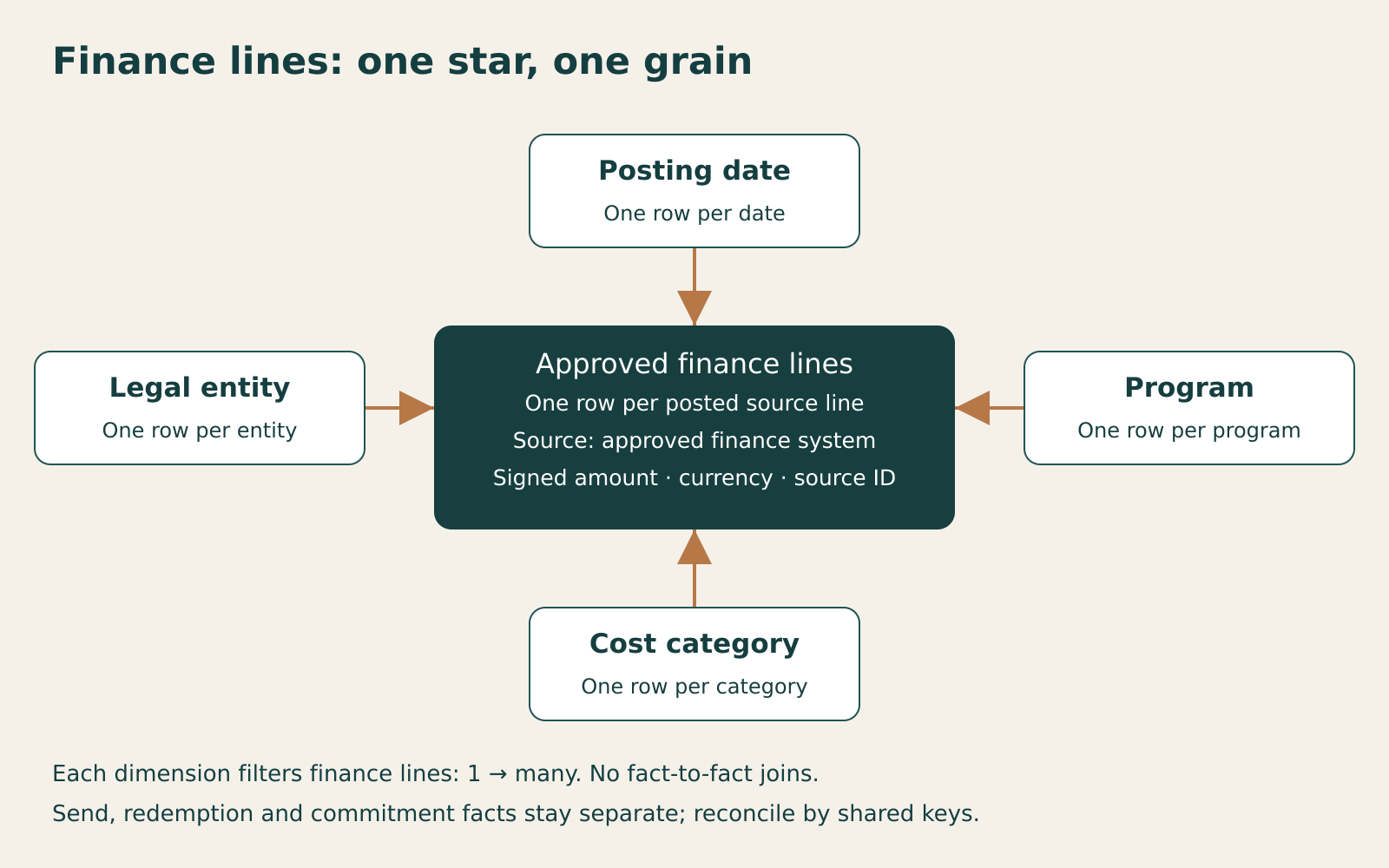
The figure is an original proposed model, not a screenshot of a vendor integration. Its financial authority is the approved finance system. Use unique dimension keys on the one side and validated foreign keys on the many side. Begin with single-direction dimension-to-fact filtering. Do not connect invoices directly to redemptions merely because both contain a program name: multiple rows on each side can multiply amounts.
Keep an explicit unknown dimension member for legitimate late-arriving references, and count those rows in a data-quality measure. Do not use it to conceal missing entities or authorization boundaries. Quarantine financially material unknown keys until the responsible owner supplies a mapping. A program label is not a durable key; two regions may use the same display name for different programs.
Date roles also need names. Posting date controls finance-period totals; send date controls invitation cohorts; redemption date describes activity timing. A February redemption of a January invitation belongs to February activity but the January send cohort. Provide separate views instead of allowing a generic date slicer to change the meaning unnoticed. For snapshots, select the agreed as-of date; adding daily commitment balances over a month is not monthly committed value.
Define measures as contracts, not convenient sums
Each published measure needs a business definition, grain, sign convention, date role, currency basis, exclusions and owner. The following dictionary is a starting contract for this design. It intentionally keeps operational quantities separate from financial amounts. Adapt the policies before implementation and retain a versioned definition when they change.
Measure dictionary: proposed definitions, authoritative sources and acceptance boundaries for the gifting spend model.
| Measure | Definition and source | Boundary and acceptance check |
|---|---|---|
| Open commitment | Approved unfulfilled commitment balance at one as-of date, from purchasing. | Exclude canceled lines; never sum successive snapshots. |
| Sends | Unique successfully dispatched invitations from execution records. | Deduplicate retries by invitation identity; parcels remain separate. |
| Completed redemptions | Unique completed selections matched to the defined send cohort. | Exclude incomplete attempts; declare the observation cutoff. |
| Posted refund credits | Approved posted credit lines, stored with negative signs in finance. | A requested refund is not a posted credit. |
| Net posted cost | Sum of in-scope signed finance lines in the approved reporting currency. | Already includes credits; do not subtract the same refund again. |
| Cohort redemption rate | Completed selections divided by eligible dispatched invitations in the same cohort. | Zero denominator returns no rate; show numerator and denominator. |
| Observed program outcome | Defined later observation from the program owner's approved source. | Report linkage and timing; do not label association as incremental impact. |
Do not add commitment, invoice and payment totals together. They can represent different stages of the same obligation. Nor should the report call a prepaid balance “unused budget” without an approved definition covering restrictions, expirations and recoverability. Keep the finance meaning visible in the measure description and dashboard title.
For cost allocation, preserve the original posted line and put approved allocations in a separate derived table. Require allocation shares to total one for each included line, retain the rule version and identify the approver. A program shared by two cost centers must not acquire twice its original cost. The budget allocation guide provides the policy context; the model should implement the policy, not invent it.
Make currency and corrections reproducible
Store transaction currency and original amount even when the dashboard displays only one reporting currency. Keep the selected rate, rate date, rate direction, policy version and converted amount with the analytical lineage. A rate defined as reporting-currency units per transaction-currency unit is multiplied by the original amount. The inverse requires division. Write that sentence into the data contract rather than trusting an ambiguous column called “rate.”
Use finance-approved converted amounts when available and suitable for the report's purpose. If the model performs analytical conversion, distinguish it from booked cost and show any difference. Never sum raw dollars, yen and won under a generic currency symbol. Missing rates should block the affected converted total or make its incompleteness explicit; replacing a missing rate with one creates false precision.
Corrections should preserve lineage. A changed source line must either replace its prior version under a documented current-state rule or enter as a signed adjustment under an event-history rule. Combining both methods double-counts the correction. Keep original event time, source modification time and ingestion time so a late refund can be explained without rewriting history invisibly.
Round at the boundary finance approves, then test the consequences. Rounding every converted line can differ from converting a rounded subtotal. Your acceptance record should identify which calculation was used and the tolerated difference. These are organizational accounting choices, not universal rules supplied by the visualization tool. If policy is unresolved, publish the operational view without presenting an unapproved financial total.
Use small DAX patterns with explicit fixtures
The examples use DAX, the expression language for model calculations. The proposed finance table is already deduplicated, restricted to in-scope posted lines, and contains an approved reporting-currency amount on every included row. The refund sign is negative. These prerequisites are more important than the brevity of the formula.
Net Posted Cost =
SUMX ( FinanceLine, FinanceLine[SignedReportingAmount] )
Posted Refund Credits =
CALCULATE (
[Net Posted Cost],
FinanceLine[LineType] = "Refund"
)
Cohort Redemption Rate =
DIVIDE ( [Completed Cohort Redemptions], [Eligible Cohort Sends] )
SUMX evaluates an expression by row. CALCULATE modifies filter context, so the refund measure deliberately selects the refund category; test how it behaves beside category slicers. DIVIDE allows a blank result for a zero denominator. Define the two cohort measures separately from deduplicated invitation and selection facts. The ratio is not a shortcut for joining raw event tables.
Use a tiny fixture before a realistic load. Three approved lines of 120, 30 and minus 20 must yield 130; the refund measure must yield minus 20. Filtering to a program containing only the first and third lines must yield 100. A cohort with 80 eligible sends and 60 completed selections yields 75%. Zero sends produces no rate, not a success score. A second ingestion of the same source identifiers must leave every result unchanged.
These are documented formula patterns and expected arithmetic results, not a claim of a live tenant execution test. The implementer must run them in the actual model, with its relationships, filters and access roles, and preserve results before promotion. Add tests for a missing conversion, an unknown program, a reversed credit and a date filter. A passing grand total cannot establish that every subgroup is correct.
Worked decision one: reconcile a US program without double counting
Consider a hypothetical US customer program with an approved commitment of USD 10,000. By the reporting cutoff, finance has posted USD 8,000 of goods and USD 800 of freight, plus a USD 500 credit. The net posted cost is USD 8,300. Purchasing reports USD 1,200 still open. The program team has dispatched 100 eligible invitations and recorded 80 completed selections. These numbers describe different things and should not be squeezed into a single completion percentage.
Finance asks whether the program remains within its authorization. Under this example's approved planning rule, expected exposure is net posted cost plus the open commitment: USD 9,500. The unallocated headroom is USD 500. This is a planning comparison, not an assertion that the commitment and postings reconcile one-for-one. Finance must first confirm that the open commitment excludes portions already posted and that the credit actually reduces the program's expected cost.
The analytics owner imports source line identifiers and preserves the credit sign. Procurement supplies the remaining commitment at the same cutoff. Operations supplies the cohort and identifies late selections separately. The acceptance pack contains the 8,300 tie-out, the 1,200 open-line listing, the 80/100 cohort calculation and the source timestamps. A reviewer should be able to trace each total to its rows without requesting recipient addresses.
The tempting alternative is to calculate USD 8,000 plus USD 800 minus USD 500 minus the refund measure. Because the refund measure already equals minus 500, that formula incorrectly returns USD 8,800. Another failure is joining the three finance rows to 80 selections, which multiplies the finance amount. Repair the sign logic or relationships; do not apply an unexplained dividing factor to make the displayed total look right.
If the credit remains only requested, show net posted cost of USD 8,800 and a separate pending recovery of USD 500. Do not reduce the posted total prematurely. The finance owner closes the discrepancy only after the source confirms the credit or explains why it was rejected. Keep that decision and its cutoff with the reconciliation record.
Worked decision two: separate cohort timing from regional access
Now consider a hypothetical regional program. A January cohort contains 200 eligible invitations: 120 for one entity and 80 for another. By February 10, 90 and 60 selections respectively are complete. The overall cohort rate is 150/200, or 75%. February activity alone contains 30 completions, some linked to January sends. Dividing those 30 completions by February sends answers a different question and may produce a misleading rate.
The program owner chooses the cohort view for effectiveness and an event-date view for staffing. The analytics owner retains both send date and redemption date, plus the invitation identity linking each completion to its eligible cohort. Late completions update the cohort observation but do not change when the invitation occurred. A frozen management pack retains its original cutoff; a later view is labeled as a newer observation, not silently substituted.
Access adds another test. The first entity's operator should see 90/120, not 150/200, when the approved policy limits visibility to that entity. A viewer with no permitted entity must receive no rows. A central authorized reviewer may see both. Test the report, drill-through and any allowed exports using accounts with the intended permissions. Hiding a column or removing a page tab is not the access policy.
The official row-level security documentation makes an important boundary explicit: workspace Viewer users are restricted by these rules; Admin, Member and Contributor roles are not. Do not test only with the developer's elevated account and conclude that ordinary users are secure. Manage membership and privileged roles separately, and retest after a person changes region or job.
If a recipient moves between entities, decide whether the cohort retains the entity at invitation time or follows current assignment. The example retains invitation-time ownership for historical comparison. Access policy may still require different current visibility. Model those as separate decisions, and involve the security owner before changing history or permissions to solve a reporting inconvenience.
Operate refresh and reconciliation as one controlled cycle
The data refresh documentation distinguishes imported-data refresh from refreshing report visuals. Reloading a chart does not guarantee that an imported model has received a newly posted credit. Display the source cutoff, ingestion completion and model refresh completion separately. A green refresh icon is not proof that the source extract was complete.
Start with a cadence justified by the decision. A monthly cost review may tolerate a daily controlled load; an active event may need more timely exception visibility. Confirm available capacity, credentials, gateways where relevant and source delivery expectations in your environment. Do not promise a universal refresh frequency or “real time” simply because a report opens quickly. Use a last-known-good view with a visible stale-data warning when a required feed fails.
For every cycle, compare source and accepted row counts, unique identifiers, signed totals by entity and currency, unknown keys, rejected records and cutoff timestamps. Reconcile finance totals to the approved source before investigating operational timing differences. Keep small differences visible with approved reasons; do not write a miscellaneous adjustment that erases the evidence. Assign each unresolved item an owner, due date and next action.
Test recovery deliberately. Replay the same extract and confirm unchanged results. Introduce a duplicate invitation and confirm rejection. Remove a required currency rate and confirm the converted result is not presented as complete. Add a late credit for a closed period and verify the agreed restatement or current-period treatment. Change a source column in a test environment and ensure the contract failure reaches the responsible operator.
Use this implementation checklist after reconciliation: finance signs the measure dictionary; operations signs event meanings; security signs audience tests; analytics records fixture results and source lineage; a separate reviewer checks the final report. Keep the rollout narrow until a full cycle and a correction replay both pass. If any signer cannot reproduce a result, retain the last accepted version while repairing the exact defect.
Choose the execution layer after the evidence model works
A reliable gifting spend model does not make every number equal. It explains why commitments, operations, posted cost and outcomes differ, and gives each difference an accountable owner. Start with one program, one reporting currency and a small set of explicit measures. Expand only after source completeness, duplicate handling, access restrictions and period reconciliation remain reproducible.
A controlled file process may be sufficient for a small stable program. A governed integration or warehouse becomes more useful as sources and history grow. Giftpack can be evaluated as a gifting execution platform within that architecture; confirm the authorized data access, identifiers, statuses and correction behavior needed for your model. No native Power BI connector is assumed here. The platform does not replace your finance, tax, privacy, payroll or employer decisions. Bring the agreed source contract and reconciliation tests to the implementation discussion so the commercial conversation starts with evidence requirements.