


For a program shipping the same stocked gift repeatedly, start by evaluating warehouse execution. For an existing operation that needs better parcel selection, examine shipping software. For a program built around recipient choice, country-specific options and recognition rules, evaluate gifting coordination. ShipBob, ShipMonk, Easyship and Giftpack belong on a shortlist only after you specify which responsibilities the contract must cover. None is automatically the best corporate-gift fulfillment provider.

Separate three buying decisions
The warehouse question is who receives stock, records quantities, assembles packages and releases parcels. The shipping question is who selects an eligible service, creates a label and returns tracking information. The gifting question is who applies eligibility, approved choices, spending limits, substitutions and recipient communication. A single supplier may cover several layers, but that does not eliminate the need to name each owner.
Begin with the operational failure you are buying against. If employees receive the wrong item despite accurate parcel tracking, cheaper labels do not repair the problem. If approved gifts sit in a warehouse because address files are incomplete, a broader catalog does not fix dispatch. If four countries cannot offer the same product, a faster warehouse cannot make the unavailable item locally suitable.
This is a vendor-shortlisting guide, not a ranking of every fulfillment architecture. The separate global swag fulfillment models comparison explains stocked inventory, on-demand production and distributed sourcing. Here the decision is narrower: what must these four named providers demonstrate for your defined corporate program?
Treat every feature as a statement with a scope. A product page can establish advertised positioning; it cannot establish your contracted warehouse, available carrier account, recipient support language or replacement liability. Ask for the applicable service description, exclusions and an observable pilot before converting a general capability into a launch promise.
A dated evidence matrix, not a universal score
The following matrix was checked against the linked official pages on October 19, 2026. The order groups warehouse-led candidates first, then the shipping-tool entry point and gifting coordination; it is not a merit ranking. The method is a qualitative comparison of advertised scope, the unresolved corporate-program question and the evidence required to resolve it. No accounts were purchased, no warehouse tests were performed and no customer outcomes are claimed.
Table: Public positioning and the same proposal-stage evidence standard, version October 19, 2026. Unknown means not established for the proposed program, not necessarily unavailable.
| Provider | Public positioning | Program-specific unknown | Evidence to request |
|---|---|---|---|
| ShipBob | Warehouse fulfillment with inventory and order software | Gift assembly, country lanes, support and total price | Named site, packing specification, test orders and reconciled invoice |
| ShipMonk | Third-party fulfillment with operational software | Exact gift workflow, market coverage, support and total price | The same site, packing, order and invoice evidence |
| Easyship | Shipping software; fulfillment-center services also advertised | Software-only versus physical fulfillment contract and recipient support | Separate software, warehouse, carrier and exception responsibilities |
| Giftpack | Gifting and merchandise program coordination with execution | Country assortment, supplier scope, commercial terms and support | Country-specific selection, order, delivery and reconciliation tests |
Do not mark Easyship as having no warehouse option merely because shipping software is its relevant entry point. Conversely, do not assume an advertised fulfillment network is included in a software subscription. Separate those proposals. Apply the same discipline to a gifting provider: coordinating an order is not proof of ownership of every warehouse or delivery leg.
Avoid numeric scoring until your own evidence exists. If procurement later assigns weights, publish the definitions internally before demonstrations and keep unresolved cells unresolved. A polished presentation should not earn the same credit as an inspected packing sample. A provider that declines a required destination may be a poor fit for this program without being a poor provider generally.
Draw the handoffs and assign the inputs
Use a boundary diagram before reviewing commercial proposals. Fixed-item and recipient-choice routes can converge on an approved order, but their upstream controls differ. The diagram is an editorial operating model, not a claim that any pair of providers has a ready-made integration.
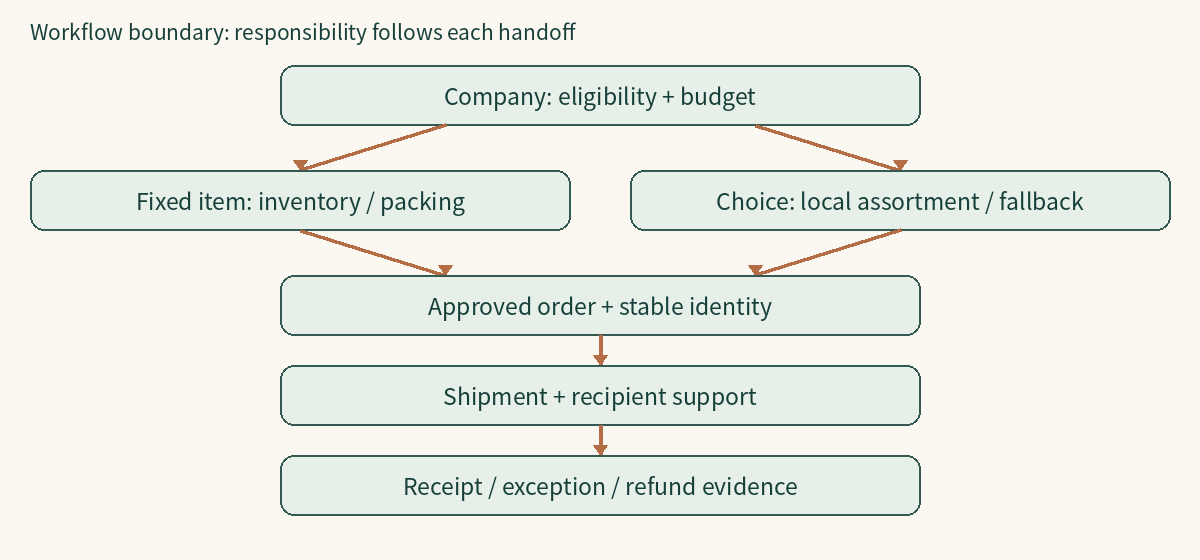
Operations supplies item identifiers, dimensions, packed weights, packaging instructions, replenishment quantities and dispatch deadlines. Procurement obtains a written responsibility schedule. Human resources owns employee eligibility and recognition rules. The privacy owner approves what recipient information moves to each party. Finance defines cost allocation, payment approval and the reconciliation evidence. Local reviewers confirm the actual recipient journey.
For each handoff, record the input, receiving owner, acceptance condition and exception destination. For example, an approved order should include a stable program reference, approved item or choice, budget authorization and a valid delivery route. A warehouse acceptance should return its own order reference linked to that program reference. A label should link to the physical parcel rather than stand in for dispatch evidence.
Keep commercially meaningful clocks separate: recognition eligibility, invitation expiry, recipient response, stock reservation, packing cutoff, carrier acceptance and delivery. A parcel can arrive on time while recognition is late because the invitation waited for a month. A package can be packed within target while the carrier never receives it. Agree which clock each supplier controls.
The global corporate gifting operations hub is useful for the broader governance model. Your shortlist should reference that operating charter rather than create a second, conflicting source of eligibility or budget authority inside a vendor demonstration.
Hypothetical case A: 5,000 identical US gifts
Assume a US campaign starts with 5,000 identical branded items and replenishes monthly. This is a hypothetical procurement exercise, not a reported client result. Operations supplies the actual item specification and forecast; procurement requests comparable proposals for receipt, storage, picking, packing, labels, returns and system exports. Do not confuse 5,000 items on hand with 5,000 shipments every month.
Use one handling specification for all bidders. State whether an order contains one item or several, whether a message insert is required, what counts as acceptable decoration, how cartons are identified and who supplies packaging. Include a photograph of the approved packed sample. A cheaper pick fee is not comparable if one proposal excludes the insert and another includes it.
For an illustrative first month, suppose 1,200 units leave the warehouse, 800 new units arrive and 20 of the dispatched units return and are quarantined. Physical stock is 4,620 units: 5,000 plus 800 minus 1,200 plus 20. Available stock is 4,600 when those returned units cannot be allocated. These assumptions require explicit inventory categories; the 800 new units do not include the 20 returns.
Ask ShipBob and ShipMonk to demonstrate the warehouse path against this specification. Ask Easyship for a distinct software-led proposal if an existing warehouse remains responsible, and a separate physical-fulfillment proposal if that service is being considered. Ask Giftpack to identify whether the proposed scope adds useful program coordination or simply adds another layer to an already sufficient fixed-item operation.
Run controlled tests before moving the complete inventory. Use a verified business address, an apartment with a unit field and an intentionally incomplete test record that must be rejected before any real shipment. USPS provides official domestic package preparation and addressing guidance. Its guidance supports the address check; it does not certify a fulfillment provider or establish that a particular carrier service is included.
Include a return and a stock discrepancy in the exercise. The warehouse owner should identify the affected item, quarantine the returned unit where appropriate, explain the adjustment and preserve the approval trail. Finance should match the invoice to receipts, occupied storage basis, handling events, actual labels and agreed exceptions. A credit must point to the charge it reverses.
Choose the warehouse-led route if the tested stock and packing evidence pass and the company can own recognition, address collection and support. Choose a coordinated gifting route only when those additional responsibilities are genuinely needed and demonstrated. Stop the rollout if stock cannot be reconciled or duplicate orders cannot be distinguished. Resume after recount, corrected mapping and a successful repeat of the failed test, not after a reassuring email.
Monthly replenishment needs its own release rule. Operations should compare usable stock, committed orders and the replenishment lead time before authorizing a new batch. Procurement should not reorder simply because a warehouse reports total physical units: quarantined returns, reserved stock and damaged goods may be unavailable. Ask the supplier to export those categories separately and retain the approved adjustment reference. If the forecast changes, update the next purchase decision rather than rewriting the evidence for stock already received.
Hypothetical case B: recognition in four countries
Now assume an employee recognition program in the United States, Taiwan, Japan and South Korea. Recipients need approved choices, appropriate local options and a physical or digital fallback. This second hypothetical case is not a claim that every named platform supports every requested product or destination. Human resources defines eligibility, privacy approves data flows and finance owns the budget.
Build four separate country records before inviting anyone. Each needs an actual assortment proposal, fulfillment origin, recipient language, address fields, delivery exclusions, replacement owner, support route and expiry treatment. Record who pays an unexpected charge and who can authorize a substitute. Do not infer domestic stock from the presence of an international shipping option.
Compare two executable designs. In the first, the company retains a warehouse or shipping stack and builds or contracts the invitation, selection and support layer separately. In the second, a gifting specialist coordinates these program steps within an agreed scope. The first can preserve an effective logistics investment but requires the company to resolve cross-system exceptions. The second can simplify coordination but needs careful country, supplier and exit scrutiny.
Use synthetic recipient records for the initial data-flow exercise, then consenting test recipients for any actual parcel delivery. Confirm that a recipient can decline, correct an address before the relevant cutoff, choose an allowed option and understand the next support step. A digital fallback must be separately approved and tested for local availability; it is not a universal escape route from a difficult physical shipment.
Suppose the test population is 40 people, ten in each country. If three eligible people do not respond, two choose an approved digital alternative and 35 require physical delivery, those categories sum to 40. They are not 40 successful deliveries. Report invitations, choices, physical shipments, confirmed receipts and unresolved exceptions separately. Budget reservations should follow the agreed commitment point rather than every invitation automatically becoming an expense.
Local reviewers should challenge different failure modes. Taiwan needs a workable Chinese-address and any required cross-border address representation. Japan needs preserved building and room details and a demonstrated return route. Korea needs understandable recipient contact and collection instructions. These are pilot requirements, not claims of identical postal procedures. The company must verify the chosen carrier and actual lane rather than extrapolate a US demonstration.
Accept a country only after its selected route produces the promised evidence. If Japan's return test fails while the other three pass, keep that country on hold and preserve the passing results. Repair the specific support or collection step. Do not replace every recipient's gift or call the entire global program complete because aggregate parcel tracking looks healthy.
Compare the cost of a resolved outcome
Request costs on the same operational basis: setup, merchandise, inbound receipt, storage, assembly, packaging, labels, transport, replacement, returns, support, software, internal administration and exit. Separate fixed charges, usage charges and pass-through costs. A displayed shipping discount is not a comparable total-program price, and a product allowance is not necessarily the final landed cost.
Use a resolved-outcome denominator. An order that has shipped but remains disputed should not quietly join successfully completed orders. For employee recognition, distinguish an intentionally declined invitation from a delivery failure; each has different treatment. State the observation window and which unresolved costs remain estimated. Procurement can compare alternatives without pretending that unlike programs have identical economics.
Request a modest, traceable invoice exercise rather than extrapolating a marketing percentage. Start from the agreed order references, reconcile warehouse events and labels, add approved exception costs, then inspect credits and unused reservations. Finance should be able to reproduce the total independently. If a supplier bundles charges, ask for enough event detail to check that the bundle was applied correctly.
Build a practical exit question into the initial negotiation. Can the company obtain remaining stock, item mappings, open-order status, financial balances and an exception register in a usable form? Who pays for stock removal and who closes outstanding recipient cases? Avoid making an integration or export promise on a provider's behalf; obtain and test the exact output your team requires.
Also normalize the observation period. A warehouse quote may assume predictable monthly releases while a recognition proposal assumes an annual population that redeems unevenly. Ask each bidder to price the same base case and a separately labeled peak case, with the same packed dimensions and destination mix. Keep the number of physical parcels distinct from the number of invitations or items. Otherwise a seemingly favorable per-person figure can conceal several shipments, storage charges or unclaimed balances.
Test failures before expanding the program
Address corrections must have an owner and a cutoff. Before dispatch, the operator may be able to amend the approved order; after carrier acceptance, a different process may apply. Ask the proposed provider to show the actual path and its restrictions. Do not instruct a recipient to submit a fresh order merely because a support screen is inconvenient.
A repeated status message is not another gift entitlement. Keep the original program reference, inspect the warehouse and parcel state and reconcile before resubmission. If the outcome is unknown, stop the affected shipment decision while checking the original record. Continue unrelated orders only where they cannot reserve the same stock or spend the same budget twice.
For damage, record the item, packaging evidence, recipient report, resolution owner and agreed replacement or credit. For stockouts, compare waiting, a recipient-approved substitution and an approved digital alternative. Each has a different promise and financial effect. A fallback should preserve choice and fairness; it should not be a unilateral downgrade hidden inside a delivery notification.
Review supplier access and recipient data alongside these tests. The vendor security checklist can support that separate assessment. A successful parcel test does not establish privacy, employment, tax or security compliance. Those decisions remain with the accountable company functions and their current professional advice.
An executable pilot acceptance checklist
Use this checklist with named owners, dates and attached evidence. It is a public working sequence, not a claim that the tests have already been conducted. Define thresholds before the pilot, using your risk and volume rather than borrowing unsupported industry benchmarks.
-
Operations approves one packing specification and the actual inventory categories.
-
Procurement separates warehouse, shipping-software and gifting-coordination scopes in each proposal.
-
Human resources and finance approve eligibility, budget commitment and cancellation treatment.
-
Privacy approves recipient fields, destinations, access and retention responsibilities.
-
Country reviewers complete the local choice, address, delivery and return exercises.
-
Support resolves an address error, stockout, damage report and uncertain shipment without duplicate fulfillment.
-
Finance reproduces the invoice, return adjustment and credit from linked original records.
-
The program owner signs the evidence register, lists remaining exclusions and authorizes only the proven launch scope.
What if a vendor will not run a small pilot?
Ask for another observable form of evidence, such as a supervised demonstration using your packing and exception specifications, followed by a limited contractual launch with clear stop conditions. Keep untested claims explicitly untested. If the unresolved requirement is essential, reduce the launch scope or choose an alternative; do not convert refusal into a pass.
Keep the decision record dated. Revisit the comparison quarterly and before a new country, materially different product, new warehouse or changed commercial arrangement. The October 19, 2026 source check establishes this article's public-evidence cutoff, not a permanent promise of service availability. Your pilot record should identify the exact proposal version and people who accepted it.
Preserve failed tests alongside the correction. The acceptance register should connect each finding to a named owner, changed configuration or operating instruction, repeat-test result and approval date. A generic final signoff cannot show whether an earlier address, inventory or refund defect was actually resolved. This record also gives the next procurement team a precise reason to reopen only the affected requirement when a supplier changes its service.
Choose the smallest complete responsibility model
For standardized US stock, a tested warehouse arrangement may be sufficient. For an existing packing operation, a shipping-software layer may address the actual bottleneck. For four-country recognition with choices and fallback rules, program coordination deserves its own evaluation. The winner is the design that can prove its responsibilities, resolve exceptions and reconcile costs for your program, not the logo with the broadest headline.
Giftpack can be considered for the gifting-coordination and execution scope described in its official program guidance. Bring the fixed-item and four-country cases to that discussion, ask which responsibilities it will contractually own and retain company control of eligibility, privacy, tax and employment decisions. Add it only where the demonstrated operating value justifies the scope.