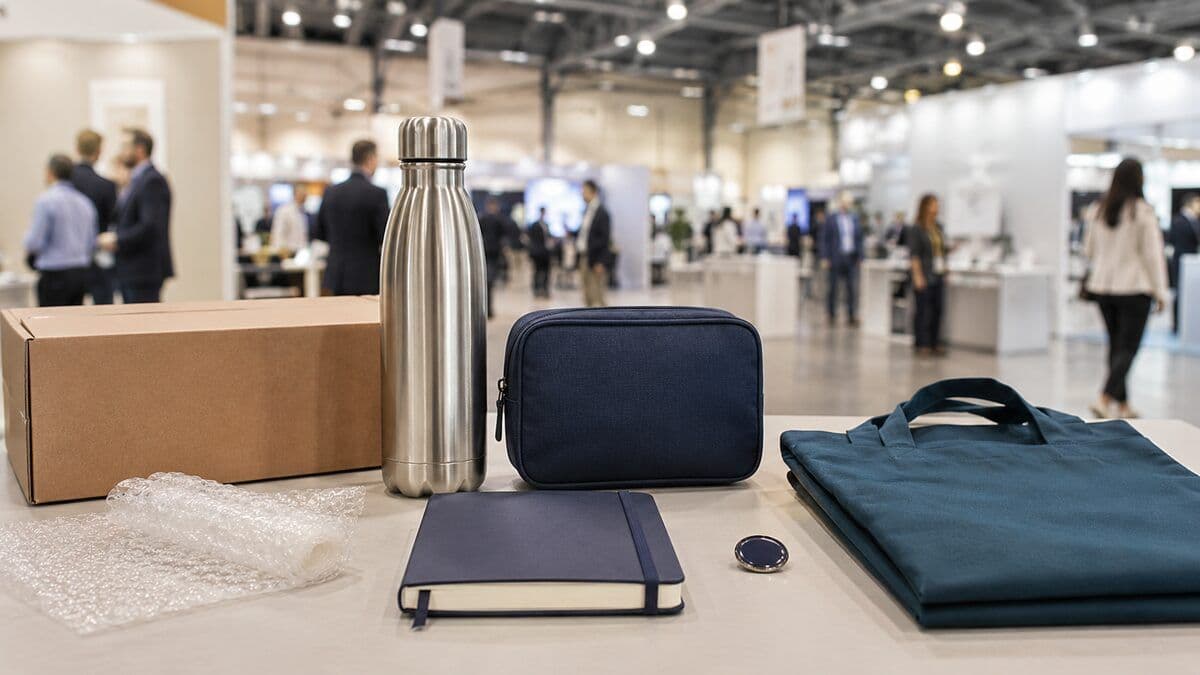


Trade show giveaways work when they help the right visitor take the next useful step—not when they merely empty a box before teardown. A global program therefore has to connect audience, item tier, quantity, production, freight, booth behavior, follow-up, and revenue evidence before anyone chooses a product.
Start with the event objective, not a product catalog
The first decision is what the event must change. A launch event may need qualified product demonstrations. A recruiting fair may need completed applications. A partner summit may need training attendance or certification. A regional conference may be valuable because named accounts agree to follow-up meetings. “Brand awareness” is too broad unless the team defines the audience, observable action, and time window. Write a one-page event brief before requesting products. Record the priority audience, target accounts, expected traffic, booth hours, offer, desired next step, data fields, privacy notice, country, venue, budget owner, delivery date, and owner for leftovers. Separate the total event budget from the giveaway budget. Booth construction, labor, drayage, scanning, travel, storage, duties, and post-event delivery all compete for the same outcome. The U.S. International Trade Administration treats staffing, first impressions, lead capture, and networking as connected parts of trade-show strategy. That is a useful operating principle: an item cannot repair an unclear booth message, poor qualification, or missing follow-up. The giveaway should support the conversation, reward a meaningful action, or extend the experience after the event. Define three success statements:
- Visitor value: what a qualified attendee receives or can do.
- Business action: the observable next step, such as a demonstration, meeting, application, or opt-in.
- Operational proof: the scan, distribution record, shipment state, or campaign response that shows the action occurred. If the team cannot complete those statements, pause sourcing. Choosing a bottle, tote, notebook, or charging accessory first usually creates an attractive expense without a defensible role.
Build a tiered giveaway strategy
One item for every visitor is simple but inefficient. A better design uses tiers tied to audience value and behavior. The lowest tier can support broad engagement; the middle tier can recognize a qualified conversation; the highest tier can be reserved for a scheduled meeting, completed demonstration, partner milestone, or post-event delivery. Tiering protects budget and makes booth staff decisions more consistent. Giveaway-tier planning table — version 2026-09-03
| Tier | Who qualifies | Purpose | Typical format | Control | Evidence |
| Open | Relevant visitor who engages | Start a useful interaction | Small, light, broadly useful item | Daily bin allowance | Manual count or scan class |
| Qualified | Buyer, user, partner, candidate, or media contact meeting criteria | Recognize a substantive conversation | Higher-utility item or compact kit | Staff approval after qualification | Contact record plus tier |
| Priority | Named account, speaker, executive, customer, or booked prospect | Extend the relationship | Premium item, curated kit, or recipient-choice follow-up | Named allocation | Meeting, redemption, delivery, and outcome |
| Recovery | Qualified contact when stock, size, or destination is unsuitable | Preserve the promise without carrying every variant | Address-free claim or post-event shipment | Unique invitation and expiry | Invitation, selection, shipment, delivery |
Do not use price alone to define a tier. Consider utility, packability, accessibility, safety, cultural fit, climate, expected lifespan, and the likelihood that the item will survive the trip home. A bulky low-cost item may create more freight and waste than a compact higher-cost item. Apparel can be valuable but introduces size mix, exchange, and leftover risk. Food can be memorable but brings allergen, shelf-life, temperature, and border questions. Battery products require route and venue review. Avoid manufacturing artificial scarcity that frustrates attendees. Publish the action required for a premium tier when appropriate, train staff to apply it consistently, and preserve an equivalent recovery path. The objective is fair allocation, not gamification at any cost.
Forecast quantity with an explicit calculator
Quantity planning should begin with traffic and conversion assumptions, then be constrained by storage and distribution capacity. Do not order one item per registered attendee. Most attendees will never pass the booth; some will visit more than once; and different tiers have different conversion rates.
Use the following planning model for each tier:
planned units = event attendance × booth reach rate × tier qualification rate × acceptance rate × (1 + buffer rate)
For example, an event with 8,000 attendees, a 12% expected booth reach rate, a 55% open-tier qualification rate, a 90% acceptance rate, and a 10% buffer produces 523 planned open-tier units after rounding up. This is a scenario, not a benchmark. Replace every assumption with evidence from prior events, organizer data, booth location, session schedule, staffing, and the current offer.
For qualified and priority tiers, start from the sales or program plan rather than total attendance. If the team targets 120 qualified conversations and expects 75% of qualified visitors to accept the item, a 10% buffer produces 99 units. For 35 named-account meetings, reserve named inventory rather than allowing it to merge with public stock.
The buffer should cover known uncertainty, not hide weak planning. Use a smaller buffer when the item is replenishable locally or reusable across events. Use a larger, explicitly approved buffer when delivery uncertainty is material and the remainder has a defined next use. Record a stop rule: if distribution is ahead of qualified conversations by a chosen threshold, the booth lead reduces the open-tier release rate.
Budget with landed event cost:
landed event cost = product + decoration + sampling + packaging + inbound freight + duties and taxes + venue handling + storage + booth labor + return or disposal + post-event shipping
Then divide by the outcome that matters. Cost per unit is a procurement metric. Cost per qualified conversation, completed demonstration, accepted follow-up, or influenced opportunity is a business metric. Keep both.
Select products, decoration, and packaging as one specification
A product choice is incomplete until the team approves the exact model, material, dimensions, color, decoration method, artwork size, placement, packaging, carton count, country of origin, destination eligibility, quality tolerance, and substitution rule. A sample that looks right under office lighting may behave differently after mass production, freight compression, or repeated booth handling. Choose utility for the audience and context. A compact cable organizer may suit a technology conference; a durable notebook may support an education or professional-services event; a reusable bottle may be useful when venue refill access is clear. Do not imply that any product is universally sustainable. Sustainability depends on material evidence, production, transport, useful life, reuse, and end-of-life options. Ask for documentation behind environmental claims and avoid vague labels. Decoration affects schedule and risk. Screen printing, transfer, embroidery, engraving, and full-color processes have different setup, proofing, color, surface, durability, and minimum-order constraints. Approve a physical preproduction sample for a new combination of product, color, artwork, and process when the consequence of error is high. Record the approved sample with photographs, measurements, approver, date, and accepted tolerances. Packaging should serve operations. Individual wrapping can protect a finish but increases opening time and waste. Bulk-packed items can speed replenishment but may scuff. Kits improve perceived value but add assembly, component shortage, dimensional weight, and inspection steps. Carton labels should let staff identify event, booth, tier, carton sequence, quantity, and opening priority without exposing sensitive recipient information. Use the broader corporate merchandise program to govern approved artwork, product evidence, suppliers, and retirement. The event guide should inherit those controls rather than create a temporary exception for every show.
Work backward from the venue delivery window
The “need date” is not the day the show opens. It may be the advance-warehouse cutoff, direct-to-show window, booth installation appointment, staff hand-carry time, or local quality-control date. Obtain the current exhibitor manual and official service-provider instructions for the specific event, venue, and year. Do not copy last year’s labels or dock rules. As one dated example, the CES exhibitor manuals publish venue-specific material-handling rates and minimums; the same official guidance distinguishes advance and direct shipments and notes a small-package allowance at listed venues. Those figures are not universal rates. They show why the team must price venue handling separately from carrier freight and verify the current venue section before shipping. Use a twelve-week planning path for a standard custom order, then compress only with documented trade-offs:
- Weeks 12–11: approve objective, audience, tiers, budget, countries, owner, and fallback.
- Weeks 11–10: confirm product eligibility, suppliers, decoration, samples, route, venue manual, and customs owner.
- Weeks 10–8: approve artwork and physical sample; lock quantities and named allocations.
- Weeks 8–5: produce, inspect in process, and confirm carton plan and documentation.
- Weeks 5–3: complete final quality check; dispatch international or long-haul freight with contingency.
- Weeks 3–2: deliver to advance warehouse or regional staging; reconcile receipt and damage.
- Week 1: train staff, stage daily stock, test scanning, and print the exception contacts.
- Event days: count opening, replenishment, distribution by tier, exception, and closing stock.
- Week +1: recover, transfer, donate, recycle, or close leftovers under the approved plan.
- Weeks +2 to +6: run follow-up, reconcile invoices, and report outcomes. The Global Corporate Gifting Lead-Time Index can help structure country-level production and delivery assumptions. The event owner must still replace estimates with supplier commitments, venue windows, customs advice, and route-specific buffers.
Separate exhibit freight from consumable giveaways at the border
International events create two different logistics questions. Booth equipment, demonstration units, and samples may leave the destination after the show. Giveaways are intended to remain with attendees and be consumed, used, or carried away. Treating both categories as temporary imports can create a false customs position. The International Chamber of Commerce explains that an ATA Carnet can facilitate duty- and tax-free temporary admission for eligible goods for up to one year. Its 2025 World Expo guidance also states that consumables and giveaways are excluded from the Carnet route. Therefore, build separate packing lists and seek qualified customs advice for goods that will remain in the country. Taiwan Customs similarly identifies professional equipment, exhibition goods, and commercial samples as potential temporary-admission categories while excluding perishables, goods consumed in use, goods not intended for re-export, controlled goods, and goods for processing or repair. That official distinction is especially important for a Taiwan event: free distribution stock should not be assumed to qualify because it travels beside a reusable display. For every cross-border route, record importer, exporter, product description, tariff classification, material, origin, quantity, unit and total value, intended use, whether the item returns, permits, labels, duties and taxes, payer, broker, documents, cutoff, and disposition. Ask the broker and organizer which address, contact, labels, and advance notices are required. Preserve evidence of export or re-export for temporary goods.
Exception panel: international customs, late production, controlled products, and leftovers
International customs: stop shipment until the importer, classification, value, intended use, and permanent-versus-temporary status are confirmed. Split reusable exhibit goods from giveaways.
Late production: protect the objective by substituting an already approved regional item, reducing tiers, or moving the premium experience to post-event delivery. Never skip quality or compliance review merely to fill a booth table.
Controlled or higher-risk products: route food, alcohol, batteries, cosmetics, medical claims, children’s items, plants, animal materials, and other restricted categories to the appropriate specialist before ordering.
Leftovers: use the preapproved transfer, storage, donation, recycling, return, or destruction route. Record quantity, owner, location, condition, cost, and next-use date.
Design booth distribution as a controlled workflow
The best forecast can fail if cartons are opened without control. Assign one booth operations lead per shift. Stage only the quantity expected for that shift, keep priority stock physically separate, and reconcile opening, replenishment, distribution, damage, and closing counts. Staff should know who qualifies, which scan field records the tier, what to do when stock is low, and how to offer an equivalent follow-up. Do not make a gift conditional on unnecessary personal data. Collect only what the chosen next step requires, display the appropriate notice, and distinguish a badge scan from marketing consent where applicable. If a visitor declines a scan, the team should have a clear rule rather than improvising. Event and legal owners must define that rule for the jurisdiction and organizer agreement. Train with short scenarios: a repeat visitor; a student requesting a priority item; a prospect whose badge cannot be scanned; a customer with accessibility needs; a visitor declining the product; a journalist; a child accompanying an attendee; and a named executive arriving after the reserved quantity appears depleted. Consistent answers protect both experience and reporting. Daily control record:
| Field | What to record | Owner |
| Opening stock | Sealed and open units by tier | Operations lead |
| Replenishment | Carton, quantity, time, and handler | Stock runner |
| Distribution | Tier and qualifying action, without excess personal data | Booth staff |
| Exceptions | Refusal, damage, stockout, eligibility dispute, or recovery offer | Shift lead |
| Closing stock | Usable, damaged, reserved, and missing units | Operations lead |
| Transfer | Destination, receiver, quantity, and next event | Program owner |
Count accuracy matters because it connects supplier receipts, venue handling, staff behavior, and lead records. A large unexplained variance is not a minor inventory issue; it weakens ROI claims and may reveal poor visitor controls.
Use post-event delivery when choice or logistics matters
Carrying every color, size, premium tier, and destination to the booth is rarely sensible. A post-event invitation can let a qualified recipient choose an approved item and enter a delivery address directly. This reduces booth inventory, protects named allocations, and gives the program observable states after the show. It is not automatically cheaper; platform, production, shipping, duties, support, expiry, and unredeemed invitations must be included. Define the invitation trigger, send time, expiry, reminder policy, assortment, country eligibility, value, sender identity, address collection, privacy notice, substitution rule, support owner, failed-delivery path, and unredeemed-budget treatment. Use unique invitations and prevent an exported attendee list from becoming an uncontrolled fulfillment file. For leftovers, never default to shipping everything back. Compare return freight and handling with transfer to a nearby event, approved regional storage, employee use, donation, recycling, or destruction. A branded item may not be appropriate for every donation partner, and a product with a campaign date or obsolete claim may need retirement. Record the decision and finance treatment. Post-event delivery is also a recovery mechanism. If a qualified visitor reaches the booth after a stockout, staff can preserve the promise with an invitation rather than handing out the wrong tier or recording a false distribution. The recovery experience should be equivalent in value and clearly explained.
Measure the funnel, cost, and operational quality
Giveaway ROI should not be claimed from scans alone. Build a measurement chain that separates exposure, conversation, qualification, acceptance, follow-up, and commercial outcome. Agree on attribution rules before the event, including the time window, source-of-truth system, duplicate handling, existing opportunity treatment, and excluded contacts. Event-giveaway measurement path and evidence map
| Stage | Question | Evidence | Useful rate |
| Reach | How many relevant visitors engaged? | Observed interactions or qualified scans | Relevant engagements ÷ booth traffic estimate |
| Qualification | How many met the defined audience or need? | Required qualification fields | Qualified conversations ÷ relevant engagements |
| Acceptance | Did the item or invitation fit? | Physical distribution or accepted invitation | Accepted ÷ offered |
| Follow-up | Did the recipient complete the next step? | Meeting, demo, application, redemption, or reply | Completed next steps ÷ qualified contacts |
| Opportunity | Did the event contribute to a verified commercial motion? | Opportunity creation or influence under policy | Influenced opportunities ÷ qualified accounts |
| Operations | Was the promise delivered efficiently? | On-time receipt, stock variance, defect, delivery, support | Successful outcomes ÷ eligible cases |
Use cost per qualified conversation as an early efficiency metric, then cost per completed next step and influenced opportunity as the program matures. Report product, decoration, freight, duties, venue handling, labor, return, post-event delivery, and waste separately so the next event can improve the right component. Avoid assigning all influenced pipeline to a giveaway; the item is one part of the event experience. The corporate gifting measurement framework provides a broader model for definitions, owners, exclusions, and dashboard governance. Event teams should connect to that system rather than creating a spreadsheet whose assumptions disappear after the campaign.
Finish with a pilot that can be repeated
A sound global giveaway program is a controlled experiment. It begins with an audience and business action, uses tiers to align value with behavior, forecasts from explicit assumptions, treats the product and packaging as one specification, works backward from the venue window, separates reusable exhibit freight from consumable giveaways, and records distribution and follow-up as observable states. Run the first design with one event, a small approved assortment, three tiers at most, and a recovery option. Hold a pre-mortem before production and a reconciliation within five business days after the event. Keep the assumptions, actuals, exceptions, cost model, sample approvals, route decisions, and outcome definitions so the next event starts from evidence. Scale only after the team can explain stock variance, delivery failures, qualification quality, and the commercial next step. When an approved program needs coordinated sourcing, custom merchandise, regional production, kitting, controlled invitations, and global fulfillment, Giftpack can serve as the execution layer. Your organization still owns audience, budget, brand, customs, tax, privacy, venue, and attribution decisions; Giftpack helps carry those decisions through repeatable event operations.