



At the same time, the industry itself is broadening its definition. PPAI is moving beyond the traditional promotional products label toward the wider branded merchandise category, where growth increasingly comes from products and programs built around quality, design, experience, and long-term brand relationships.
For distributors, these signals point in the same direction. Future competitiveness will depend less on price alone and more on the ability to combine supply chain strategy, product selection, design, and proposal workflows into higher-value solutions that move faster from customer need to confirmed order.
The Short Answer
Three market signals matter most in 2026:
- Cost pressure is rising. New tariffs are reshaping import economics by country of origin, but landed cost still needs to be evaluated across the entire supply chain rather than by tariff rate alone.
- Nominal growth is not the same as real growth. Leading North American distributors and suppliers are reporting sales growth, but the rate remains below inflation, putting pressure on end-customer purchasing power.
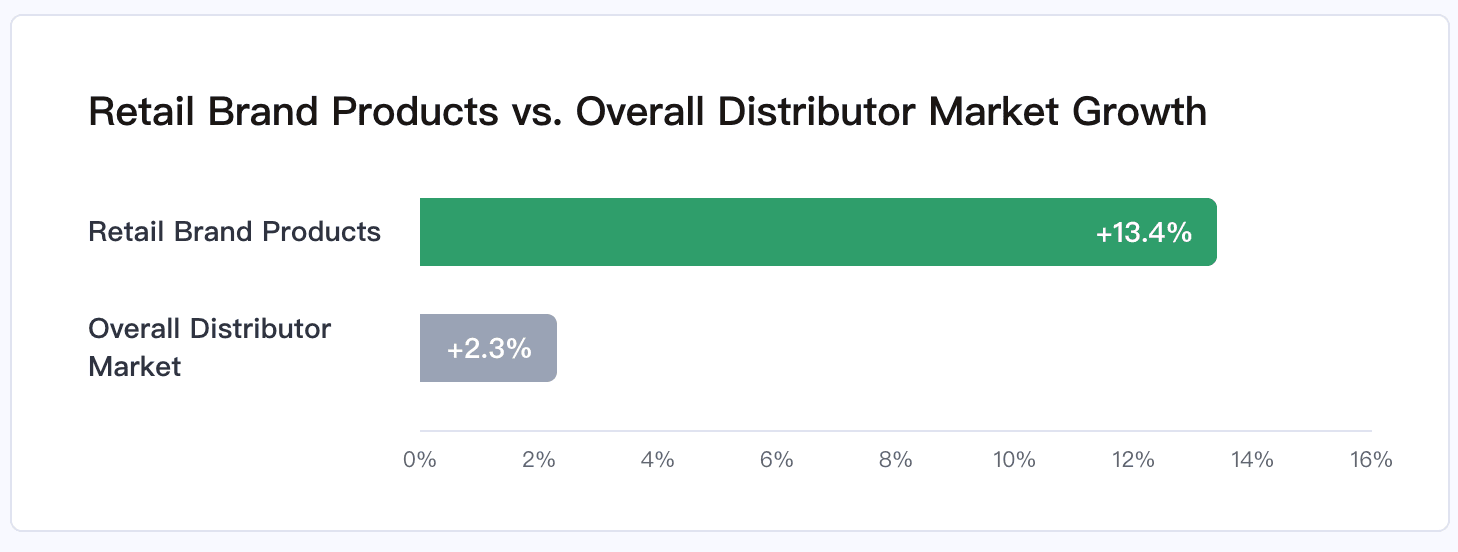
- Higher-value branded merchandise is growing faster. Retail-style branded merchandise is expanding much faster than the broader distributor market, indicating a shift toward better-quality, more design-led, experience-driven products.
In this environment, competing primarily on price can quickly compress margins. A stronger path is to improve proposal efficiency, shorten confirmation cycles, and use existing customer relationships to expand into higher-value branded merchandise programs.
New Tariffs Are Reshaping Supply Chain Economics
Beginning July 24, 2026, the United States imposed additional tariffs under Section 301 of the Trade Act of 1974 on most imports from 60 economies. USTR estimates that the measures cover roughly 99% of imports. Beyond the overall increase, the added tariff rate differs by country of origin, changing how sourcing options need to be compared.
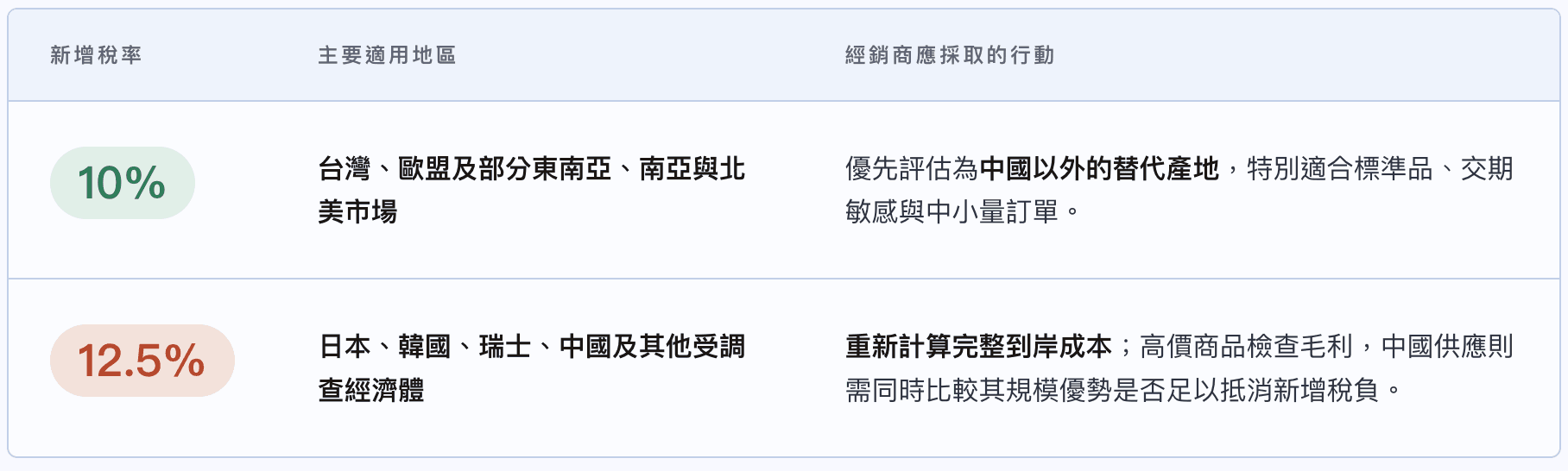
Higher tariffs, however, do not automatically mean that imported products have the highest landed cost.
Consider a customized stainless-steel bottle. Even when an Asian production model includes additional tariffs and international freight, a factory may still maintain an overall cost advantage through manufacturing scale, category expertise, product variety, and a more mature supply base.
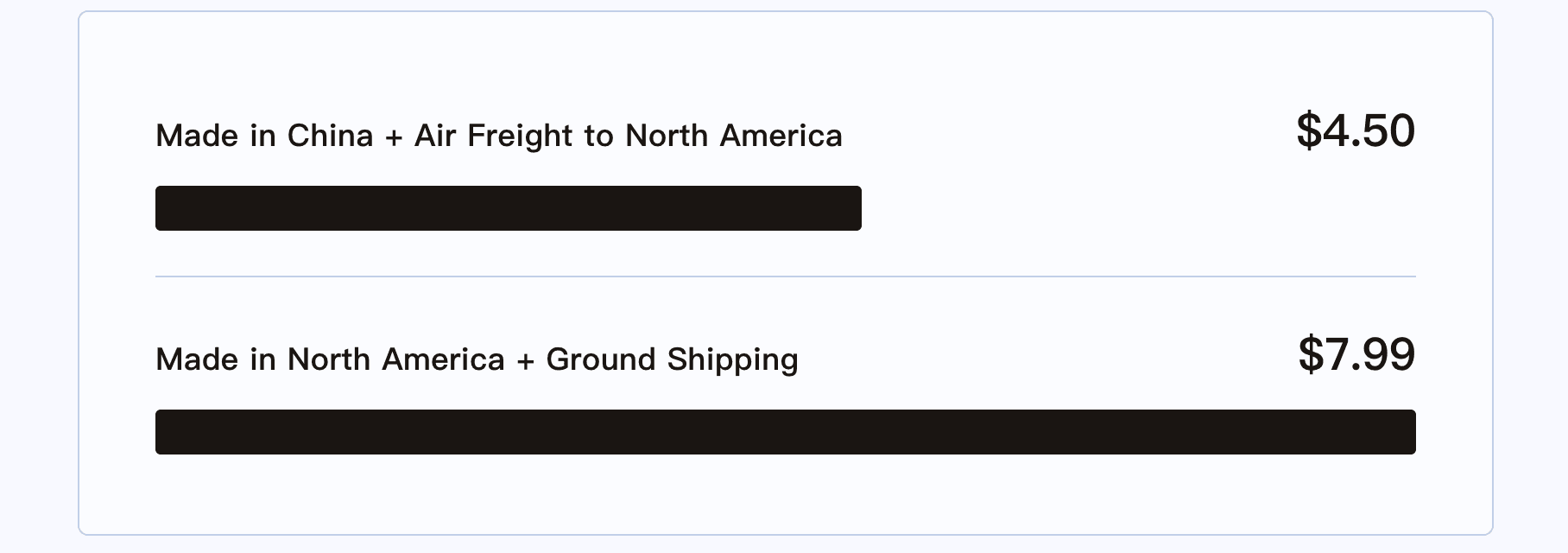
That means companies should not compare sourcing options only by asking which country has the lower tariff. They need to look at the full landed-cost structure, including:
- factory production cost
- customization and processing capability
- minimum order quantities
- supplier and category breadth
- international freight
- tariffs and customs
- domestic delivery
- quality and lead-time consistency
For distributors, the practical takeaway is not to treat Asian sourcing as automatically disadvantaged. The better approach is to understand how total cost and capability vary by product category, then match each customer need with the most appropriate supply model.
The Market Is Still Growing, But Revenue Growth Is Below Inflation
A PPAI survey of leading North American distributors and suppliers conducted in May and June showed sales growth of approximately 2.3% and 2.1%, respectively. That is one of the more positive recent signals and suggests that the market is not in a clear downturn.
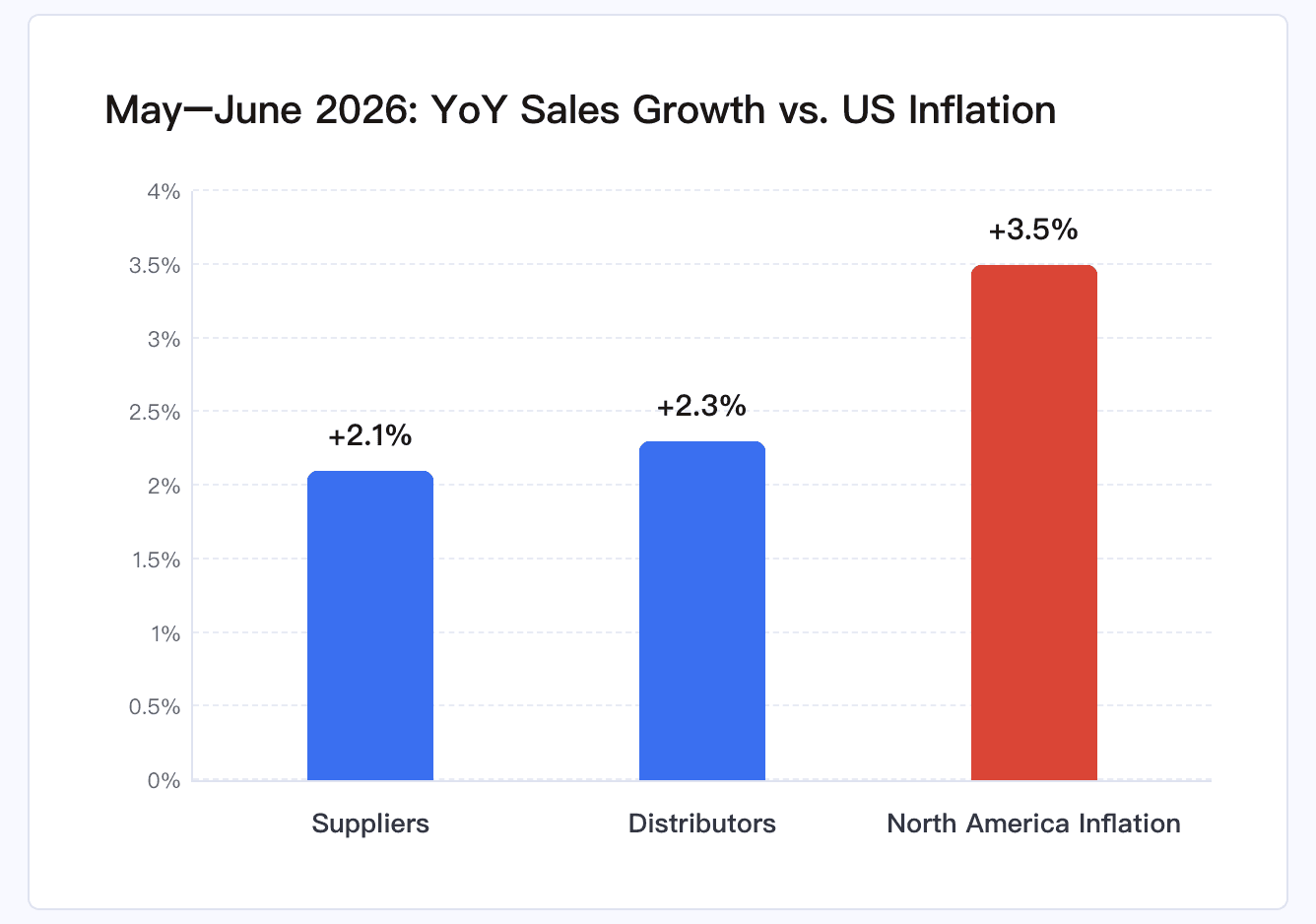
But U.S. inflation during the same period was about 3.5%.
When nominal revenue growth trails inflation, part of the increase in reported sales is simply the effect of higher prices. In practical terms, end-market purchasing power is not growing at the same pace.
For distributors, that makes price increases a less reliable path to expansion. When pricing headroom becomes limited, revenue growth increasingly depends on two things:
- winning more orders
- increasing the quality and value of each order
That makes conversion efficiency much more important.
Why Proposal Efficiency Directly Affects Growth
In a traditional branded merchandise supply chain, production and logistics are not always the biggest sources of delay. The slower part is often the work required to finalize product details before an order can move forward.
Even when an enterprise customer has a clear budget, they may still be uncertain about which products fit a particular audience or use case. Distributors then need to interpret the brief, narrow the assortment, explain customization options, prepare visuals and proposals, and manage several rounds of feedback before anything is approved.
In workflows that rely heavily on manual design or fixed templates, this process often creates:
- high production cost for proposals
- product options that do not fully match the brief
- inconsistent visual quality
- repeated revision cycles
- confirmation timelines that can stretch for weeks or even months
When real market growth is limited, these front-end communication costs directly limit how many projects a team can handle at once.
Digitalization and automation can consolidate repetitive work and turn a vague brief into a more concrete product recommendation and visual proposal much faster.
This is one of the areas Giftpack is focused on:
Proposal automation helps distributors reduce design and communication costs, shorten proposal cycles, and use the same headcount to deliver more relevant, highly customized options with clearer customer communication, ultimately improving conversion efficiency.
The opportunity is not only to make a proposal faster. It is to improve the entire commercial workflow from need discovery and product selection to customer confirmation.
From Promotional Products to Branded Merchandise
Another important change is how the industry defines itself.
In its 2026–2030 strategic plan, PPAI expands the industry from the traditional concept of promotional products toward the broader category of branded merchandise, with a vision of making branded merchandise a leading marketing connection for creating lasting relationships.
This is more than a naming change. It expands the boundaries of the market.
The broader framework includes:
- apparel
- corporate gifting
- employee engagement and rewards
- event experiences
- retail-style branded merchandise
- online and digital channels
Branded merchandise is no longer only an accessory to a one-time marketing campaign. It is increasingly part of how companies manage brand relationships, employee experience, and customer engagement.
That also changes the value distributors can provide.
As products move closer to retail expectations for quality, design, and experience, distributors are no longer simply sourcing “something with a logo.” They can extend into higher-value brand experience solutions.
Higher-Value Merchandise Is Growing Faster Than the Broader Market
The shift is already visible in market growth.
While the overall distributor market is growing only around 1% to 2% annually, the U.S. retail-style branded merchandise market reached approximately $6 billion in 2025 and grew 13.4% year over year.
That means the fastest growth is not coming from low-cost, highly commoditized promotional items. It is coming from products and programs with stronger:
- quality
- design
- brand identity
- user experience
- retail value
This is especially relevant for Asian suppliers and distributors.
The perceived market ceiling is often not a lack of demand, but a narrow definition of the business. If a company sees itself only as a promotional item supplier, every customer request looks like a single product order and the market naturally feels limited.
But the same enterprise customer may have multiple branded merchandise needs, including:
- employee onboarding kits
- event giveaways
- premium business gifts
- branded online stores
- retail collaborations
- long-term employee reward and engagement programs
These needs already sit inside the same customer relationship.
The Bigger Opportunity Is to Reinterpret Existing Customer Demand
Moving from promotional products to branded merchandise does not necessarily require entering a completely unfamiliar market.
The more practical opportunity is to use existing customer relationships and expand one-off product orders into broader brand experiences.
A distributor that initially supports event merchandise, for example, may later support onboarding kits, VIP customer gifts, branded storefronts, or longer-term incentive programs. As the engagement expands from a single item to a fuller solution, the strategic value, differentiation, and margin potential can increase as well.
The opportunity is not necessarily to enter a new market. It is to reinterpret the business you are already serving. Existing customer relationships can be extended into solutions with stronger retail quality, better design, more experiential value, and measurable outcomes, creating a more defensible, higher-margin, and longer-term business.
How Giftpack Helps
As the market shifts toward higher-value branded merchandise, execution becomes more complex.
Customers expect more customization, stronger visuals, faster response times, and more precise product recommendations. If a team still relies on manual product research, design, and proposal preparation, it becomes difficult to scale both order volume and service quality at the same time.
Giftpack is built to combine product selection, customization, proposal workflows, and global supply chain execution into a more scalable operating layer.
With AI-powered proposal automation alongside global sourcing, customization, and fulfillment capabilities, distributors can turn customer needs into concrete product options and visual proposals faster, reduce back-and-forth communication, and increase their capacity to support higher-value branded merchandise programs.
Final Takeaway
Tariffs and inflation are reducing the room for pure price competition, but that does not mean the branded merchandise market lacks growth.
Instead, growth is increasingly concentrated in higher-quality, more design-led, experience-driven branded merchandise. For distributors, the next stage of competitiveness comes from two directions: understanding full supply chain economics rather than tariff rates alone, and improving the workflow from customer need to product selection and proposal confirmation.
As the market moves from promotional products to branded merchandise, the opportunity is not simply to sell more items. It is to turn existing customer relationships into broader, higher-value, more sustainable branded merchandise business.